Showing posts with label Kim Ki-Duk. Show all posts

Wednesday, December 20, 2006

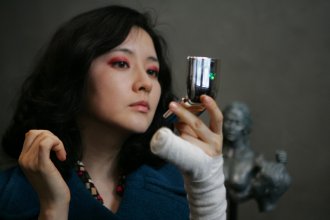
Kim Ki-Duk's Time

Kim Ki-Duk is one of the most consistently interesting filmmakers working today, creating movies that all inhabit a universe of their own, a universe he's been building over ten years of filmmaking. Typically, his films feature a minimum of dialogue, and center around prostitutes and/or water. Time represents a departure from some of these trademark themes, the characters talk quite a bit and though there is some water, there's no prostitutes. Time is a more conventional film than his previous works, taking on aspects of conventional thrillers rather than the discomforting bizarreness of his other works. I think that makes it an easier film to watch, but one that is less consistent in achieving the odd magic only he is capable of.

For me, the film's opening chunk is the most problematic. Kim Ki-Duk is frequently accused of making misogynistic films, a criticism that I would generally consider widely off base. The exploration of women in 3-Iron or Samaritan Girl is nuanced and emotionally true. Yes, he puts his female characters through some awful ordeals, but so did Douglas Sirk, and he's hailed as one of the finest directors of female characters. In 3-Iron or Samaritan Girl, we're made to understand why the women are suffering, and we experience the moments of violence that they undergo right with them.

What makes this opening troubling is that Seh-Hee's motivation is completely irrational. She winds up seeming shrill and unsympathetic. Watching this through, I was troubled by the lack of shading in her character. We are meant to consider this behavior ridiculous, and the end of the film demonstrates that Seh-Hee is now aware of how ridiculous what she did was. However, that growth doesn't excuse her irrationality in that moment. Considering the whole film hinges on this, I think it would have been possible to treat her jealousy in a more rational way.

Like a lot of Kim-Ki Duk films, this has a dual perspective structure. We follow Ji-Woo for the first half of the film, his struggle to deal with Seh-Hee's sudden disappearance. The film is designed to show that the love Seh-Hee and Ji-Woo had was great, giving them both exactly what they needed. In the moments where they're together, there is happiness. Outside, they are unable to find that same connection with anyone else, and yet, through their fear of losing each other, they wind up destroying their relationship.

Ji-Woo's journey into the dating world reinforces the superficiality he feels trying to be with anyone but Seh-Hee. His love for her creates a deep guilt about seeing anyone else, and his attempts to actually be with anyone only spiral into worse and worse situations. I'm not sure if the broken glass in the hotel is actually caused by Seh-Hee, that doesn't matter so much. In Kim's films, character psychology is reflected in the conditions of the physical world, so his guilt about being with someone other than Seh-Hee is made physical through the breaking glass. Something similar happens later when Seh-Hee goes to the man's apartment and find a whole bunch of evidence to lead her to belive it's Ji-Woo, the world reflects her desires.

By this point, Seh-Hee has given herself quite a conundrum, she is competing with herself for Ji-Woo's affections. She has a wonderful time with him at the sculpture park, but he remains tied to Seh-Hee. I'm not sure what she wants him to say when she asks what he'd do if Seh-Hee came back? Does she want him to say she's over the old her, fully in love with the new one, or would that in fact validate the very fears that motivated her to get plastic surgery in the first place? Basically, neither answer is good and there's no way for her to be happy, because telling the truth would make Ji-Woo think she's insane.

And that's what happens in the fabulously bizarre scene where Seh-Hee goes to see him with the mask on. That mask was very freaky, the sort of lo-fi, but deeply disturbing scare that Lynch put to great use in Inland Empire. This film is the turning point of the film, where our perspective switches from Ji-Woo's to Seh-Hee's. The parallel structure is nice, with Seh-Hee now forced to experience the same frustration and uncertainty that Ji-Woo did in the film's first half. I'm not sure why he chose to get surgery, I suppose it's primarily to punish her for what she did. At this point, Ji-Woo disappears from the story and we experience Seh-Hee's pain. Here, Seh-Hee sees the folly of her plan, she condemned Ji-Woo for looking at some women, but now she looks at every man, thinking that they could be the one she loves.

Visually, the film is less expressive than Kim's best work, his films about mute characters require incredible visuals to tell the story, here dialogue does more of the work. That said, there are still some great moments. I love Seh-Hee sitting on the hand, just above water, as well as when she lies down next to the statue.

The whole story leads up to a horrific act of violence. In Kim's films, violence is frequently the only means through which characters can express their emotions. Here, the death of someone who might be Ji-Woo indicates to Seh-Hee the full folly of what she did. She so despises herself, she again seeks to escape into the anonymity of a new identity.

This leads us back to the film's beginning, in a seemingly illogical narrative loop. How could Seh-Hee bump into herself from the future? I would aruge this, like many Kim conclusions, makes sense from a psychological perspective, not a literal one. Earlier, when Seh-Hee sits down at a man's table, she seems to initiate a similar loop as the one that led to her own plastic surgery. So, jealousy becomes a vicious cycle, perpetuating itself ad infinitum. She bumps into her future self, setting up the idea of plastic surgery in the first place.

Ultimately, the film is saying that plastic surgery doesn't change anything. Because the same person is underneath, we'll still be trapped in the same behavioral loops. The ending makes this literal, she can change her appearance, completely dissolve her identity, but she can't change the person inside.

I think there's parts of this film that are very effective, but as I said before, it doesn't match up with the best of Kim Ki-Duk's work, which taps into a raw emotional power that's very rare in cinema. But, he can only make the same movie so many times, so it's good to see him moving beyond his trademark obsessions and expanding his narrative universe.

Thursday, September 07, 2006

Top 22 Directors: Part I: 22-11

Here's a list of my twenty-two favorite directors. I'm not trying to present some authoritative view of the twenty greatest directors of all time, in the history of cinema, Francis Ford Coppola's certainly more notable than Sofia in the overall development of movies, but for me personally, Sofia's work has been more affecting. The way I see it, this list's order is determined by who I'd be most excited to see a new film by. Along with the name, there's the number of films I've seen by this person, as well as the number of films they have in my personal top 100 and the number of points they have, with 100 being 1, etc.

22. Bob Fosse
Seen: 4 (of 5)
Top 100: 1
Points: 37
Best Film: All That Jazz


Fosse is best known for his choreography work, but unlike a lot of multitaskers, his films are uniquely cinematic entities. All of his films are based around show business, usually focusing on the negatives, but occasionally showing us why people get involved in the first place. He's got a very dynamic camera and can edit a musical sequence better than anyone. All That Jazz is an extremely inventive film, most notably in the finale, one of the best film endings of all time. His most harrowing film is Star 80, a brutal assault on the viewer with one of the bleakest endings of all time. That film shows that he can work well outside of the musical genre.

21. Lars Von Trier
Seen: 4 (of 8)
Top 100: 1
Points: 65
Best Film: Dogville


Lars Von Trier makes films that frequently frustrate me, he challenges the viewer and I think that the strength of emotional reactions to his material indicates the power of his filmmaking. His 'Golden Heart Trilogy' bothered me at times, but the end of Dogville rebukes a lot of the criticisms there and provides his oeuvre with a violent catharsis. His relentless experimentalism is refreshing, if nothing else, you can always count on Lars to create something different.

20. Terrence Malick
Seen: 4 (of 4)
Top 100: 1
Points: 35
Best Film: The New World


Malick makes films that invite you into a world. Much like Wong Kar-Wai he forsakes traditional narrative for voiceover laden, philosophical and emotional journeys into moodiness. He's at his best when dealing with very simple stories, like the love triangles of The New World and Days of Heaven. In this context, he allows nature to represent the characters' emotions, and gets to show off his always gorgeous photography.

19. Gaspar Noe
Seen: 2 (of 2)
Top 100: 1
Points: 75
Best Film: Irreversible


Like Trier, Noe makes films that actively confront the audience, challenging the viewer to look away. I Stand Alone is a really difficult film to watch because Noe so thoroughly immerses you in the mindset of its racist, psychotic main character. Then with Irreversible he creates his first masterpiece. It's one of the most technically dazzling films of all time, wowing you with the photography while simultaneously horrifying you with the intensity of its content. Very few films could accurately be called an experience, but Irreversible is. It's a film that changed the way I view the medium.

18. George Lucas
Seen: 5 (of 5)
Top 100: 3
Points: 229
Best Film: Star Wars


I think of Lucas more as a storyteller than a director. He didn't have to actually direct Empire or Jedi to get his vision across. However, his direction is still notable, Star Wars changed the possibility of what could be done with science fiction cinema by creating another universe that is totally believable. In Star Wars, I find it hard to believe that cameras are there or even that these people are acting, watching those films completely erases the layer of fictional awareness. People say that Lucas ended New Hollywood with Star Wars, but by creating a film that conveyed his unique vision in a traditionally creative bankrupt genre he was doing the same thing that Coppola did to the crime genre with The Godfather. It's only what happened after that caused things to go bad.

17. Gregg Araki
Seen: 6 (of 8)
Top 100: 0
Points: 0
Best Film: The Doom Generation


Araki is another director who's notable for making really challenging films. His early work is very hyped up, always messing around with film convention, be it in the meta titles on Totally F***ed Up or the genre extremism of Doom Generation. He puts a lot of effort into making visually interesting compositions and backing them with great soundtracks. Mysterious Skin is more emotional than his previous films and manages to keep the visual greatness even in a more realistic narrative world.

16. Kim Ki-Duk
Seen: 6 (of 12)
Top 100: 1
Points: 11
Best Film: 3-Iron


Kim Ki-Duk is a filmmaker who works almost exclusively with visuals and music, frequently spotlighting mute characters who communicate through facial expressions and touch rather than through words. In this sense, he makes uniquely cinematic films and there's a lot of joy to be had in watching him construct worlds out of shots. He's got a fantastic eye and can create really powerful moments through the combination of visuals and music. Sure, he's a bit repetitive, every film seems to be involve water and/or prostitutes, but his films are always interesting, so more power to him.

15. Robert Altman
Seen: 11 (of 35)
Top 100: 1
Points: 8
Best Film: Nashville


Altman's made so many films, it's hard to pin down a specific style. I could easily see the guy who made Nashville making Short Cuts, or the guy who did Images making 3 Women, but connecting everything is more difficult. However, Altman is notable for making realistic films, in the sense that they capture words as spoken, not as scripted, and emotions in an underplayed way, trauma internalized rather than shouted out. I respect Altman for continuing to work, and excel, well in to old age. A Prarie Home Companion is one of the best films of this year and his filmmaking is still innovative and exciting.

14. Park Chanwook
Seen: 4 (of 6)
Top 100: 2
Points: 67
Best Film: Oldboy


Seeing Park's Oldboy for the first time was one of my most exhilarating film viewing experiences. The effortlessness of his craft is dazzling, each frame a beautiful composition and the stylistic flourishes, backed by over the top orchestral techno score left me really happy that such a cool film existed. Lady Vengeance was one of my most anticipated films of last year and it messed with my expectations quite a bit, however I've come to love the more serious approach to vengeance he takes there. No director has a better eye for composition, for creating a really striking image, than Park.

13. Sofia Coppola
Seen: 2 (Of 2)
Top 100: 2
Points: 73
Best Film: Lost in Translation


Sofia Coppola is an even better director than her father, and I love Francis Ford's work. Both of Sofia's films exists in a dreamy realm not far removed from Wong Kar-Waiville, a world where absolutely gorgeous visuals and perfectly chosen music illustrate stories of everyday events that happen to be hugely important to the characters involved. She understands the fact that cinema is a visual medium first, a storytelling medium second, and all the critics who complained that nothing happened in Lost in Translation totally missed the point. Those moments of nothing, beautiful pauses, are where the soul of the film lies. I'm eagerly awaiting Marie Antoinette.

12. Michel Gondry
Seen: 2 (of 2)
Top 100: 1
Points: 80
Best Film: Eternal Sunshine of the Spotless Mind


Gondry is arguably the most innovative visual director working in film today. In his music videos, he went to many crazy places, and is the only director in this CG age who's still able to make you ask "How'd they do that?" Beyond his videos, he's made one masterpiece. Eternal Sunshine of The Spotless Mind is a totally unique fusion of very real emotional drama and surreal visual dreamscapes. It was such a leap for Gondry and I'm confident he's going to keep things going in his next feature, the soon to be released Science of Sleep.


Part II Coming Soon

Tuesday, January 31, 2006

My Oscar Nominations - 2005

So, if I was the one choosing the Academy Awards, here's what they would be. Before I begin however, I want to say that Oldboy and 2046 were in last year's awards. If they were around this year, they'd be omnipresent, however, I'm not bringing them back. The time has passed. Also, some of these films weren't even released this year here, so they couldn't be in the real awards. It's just the stuff I saw that was either made in 2005 or released in the States in 2005.

And another side note, I didn't think this was the best year for film. In terms of visual media, by far the best accomplishment was Six Feet Under's last season. If that was eligible, it'd be dominating the acting catergories, and the final run of episodes was more satisfying than any feature I've seen this year.

Anyway, on to my nominations...

Best Actor
Joseph Gordon-Levitt – Mysterious Skin
Terence Howard – Hustle and Flow
Heath Ledger – Brokeback Mountain
Bill Murray – Broken Flowers
Michael Pitt – Last Days


These were all amazing performances because the actors completely inhabited the character. There was no sense of acting, it was like this is who they are. However, I would give the award to Heath Ledger because his character had the biggest emotional arc, and watching him was emotionally devestating.

Best Supporting Actor
Jake Gylenhal – Brokeback Mountain
Ludacris – Crash
Ian McDiarmid – Revenge of the Sith
Nick Nolte – Clean
Keanu Reeves - Thumbsucker


This catergory has a wide variety of actors. Ludacris was the best thing in Crash, really funny, shining above the film's clumsy preaching. McDiarmid went way over the top, leaving teeth marks in the scenery but always remaining true to the character. Reeves finally returned to the stoner character everyone wants to see him as. However, my choice here is Nick Nolte, who's so sympathetic as a grandfather who knows he has no real right to the boy he's raised as a son. He's a calm presence navigating a complex emotional landscape. This performance redeems him for the mug shot.

Best Actress
Maggie Cheung – Clean
Q’Orianka Kilcher – The New World
Ji-Min Kwak – Samaritan Girl
Yeong-ae Lee – Sympathy for Lady Vengeance
Naomi Watts – King Kong


Comparing this bunch of actresses to the actors, it's pretty clear that American film isn't offering many good parts to women, and even though they're accused of misogyny, Korea's extreme directors are offering more challenging parts to women than just being "the girlfriend." However, the choice here is easy, Q'Orianka Kilcher creates the emotional anchor for The New World. Watching her over the course of this film is watching the course of America during its first few years of colonization. She goes through much and through it all we see a truth to the character. It's astonishing that she pulled off this performance, carried the entire film, at 14.

Best Supporting Actress
Maria Bello – A History of Violence
Maggie Gyllenhal – Happy Endings
Yeo-Reum Han – Samaritan Girl
Tilda Swinton - Thumbsucker
Michelle Williams – Brokeback Mountain


This was the toughest of the acting catergories to fill. There's a bunch of good performances here, but the one that stands out is Tilda Swinton. She gave three great, wildly varied performances this year, but Thumbsucker was her best. She wasn't the main character, but she was fully realized and the character could have easily carried an entire film.

Art Direction
Mirrormask
Revenge of the Sith
Sin City
Sympathy for Lady Vengenace
The New World


These were all great looking movies, but I'm going to give the edge to Revenge of the Sith. There's such a variety of environments in the film, I admire the way they simultaneously contributed a lot of new stuff to the Star Wars world, while at the same time tying stuff together with the previous trilogy. Well done.

Cinematography
Domino
Mysterious Skin
Sympathy for Lady Vengeance
The New World
3-Iron


This one's easy, The New World was so well shot, both in terms of what was shown and how it was shown. It was a uniquely cinematic story, like nothing that's come before. Not to get nasty, but if you weren't able to appreciate the cinematography in that film, why are you even watching a movie, maybe you should stick to books.

Costume Design
Charlie and the Chocolate Factory
Mirrormask
Revenge of the Sith
Sin City
Sympathy for Lady Vengeance


Mixing it up a bit here, I'm going to give the award to Lady Vengeance. It's not the most dramatically inventive work, but in terms of defining character, it's absoultely critical. Her outfit is the character, and that's what good costume design does, sell the world to the audience.

Editing
Clean
Domino
Revenge of the Sith
Sympathy for Lady Vengeance
The New World


There were two movies this year that showed me a new way of storytelling through editing, one was The New World, which used its editing to give a hypnotic rhythm to its visuals, however the best editing was in Domino, which was the only film I've seen where the most exciting part of the movie is watching the editing and seeing how far they can push the medium. It pushes the film beyond narrative to the point that it's a near avant garde visual experience.

Foreign Language
Clean
3-Iron
Samaritan Girl
Sympathy for Lady Vengeance
The Bow


It's pretty clear here that this was the year for Kim Ki-Duk, dropping three of the five films here. Of these three, the best is 3-Iron, an achingly beautiful story of two people. Kim takes words out of the vocabulary and instead creates a film which uses visuals to maximize the emotional impact of events. It's great work and the final moments of this film are some of the most haunting I've seen.

Makeup
Mirrormask
Revenge of the Sith
The New World


Sith grabs the award, if only for the stunning work on Anakin's scarred body after getting drenched in the volcano. It's disturbing stuff.

Song
“Hard Out Here for a Pimp” – Hustle and Flow
“Whoop that Trick” – Hustle and Flow
“Move Away and Shine” – Thumbsucker
“Down in the Light” – Clean
“Veruca Salt” – Charlie and the Chocolate Factory


A catchy bunch of tracks here, it is hard out here for a pimp, but I'm giving the award to Thumbsucker. The Polyphonic Spree are one of my favorite bands, and "Move Away" is one of their best songs. It's also really crucial to the film, providing the emotional conclusion.

Score
Brokeback Mountain
Mirrormask
Revenge of the Sith
The New World
Thumbsucker


These are all fantatsic scores, but I'm giving the award to The New World, a film where the score was absoultely crucial to defining the film. It's not a strictly narrative movie, so the score has to do more than just support, it has to define the rhythm of the film, and it does so admirably. James Horner has done some decent work in the past, but this goes way beyond.

Visual Effects
Charlie and the Chocolate Factory
King Kong
Mirrormask
Revenge of the Sith
Sin City


Yoda in Sith was real. I know he's CG, but he feels like a real dude, and that's the best compliment to visual effects, that you could pull of so challenging a character and make it feel seamless and real. So, that earns the award.

Adapted Screenplay
A History of Violence
Brokeback Mountain
Mysterious Skin
Revenge of the Sith
Thumbsucker


Yes, nominating George Lucas for best screenplay is a bit weird, but I'm looking at the overall story construction, not the dialogue there. However, the award here goes to Greg Araki for Mysterious Skin. This was a really well written film, balancing two fully realized characters and a strong process of gradual revelation as it proceeded. Great stuff.

Original Screenplay
Broken Flowers
Clean
Samaritan Girl
Sympathy for Lady Vengeance
The New World


I'm giving this one to Chanwook Park for Sympathy for Lady Vengeance. Park builds a complex, sympathetic, yet disturbing central character, and there's a bunch of great twists throughout. This is a better written film than Oldboy, even though the movie on a whole doesn't quite match.

Director
Olivier Assays – Clean
George Lucas – Revenge of the Sith
Kim Ki-Duk – 3-Iron
Chanwook Park – Sympathy for Lady Vengeance
Terence Malick – The New World


These were all films that worked because of very strong direction, unique films that used the medium in incredible ways, however, the best direction was Terence Malick's for The New World. In the film, Malick builds a world that's completely believable as the past, yet has an essential humanity that makes it feel contemporary. It's the rare period piece where you get the sense of real people living these events, and that's largely due to the wonderful performances from everyone in the cast. And beyond that, just visually, the film is astonishing. It's like nothing else I've ever seen.

Picture
Revenge of the Sith
3-Iron
The New World
Sympathy for Lady Vengeance
Clean


There was one film this year that took me on an incredible emotional journey and at the end left me feeling completely satisfied, even after waiting for the film for virtually my entire life, and that's Revenge of the Sith. It's not perfect, but it achieves so much, and is full of rich thematic development on a scale rarely seen in movies. It's incredible visuals used to create an emotional effect in a way that only film can do, and that's why it's my best picture of the year.

And just to tally everything up, here's the winners:

The New World - 4
Revenge of the Sith - 4
Sympathy for Lady Vengeance - 2
Thumbsucker - 2
3-Iron - 1
Clean - 1
Domino - 1
Brokeback Mountain - 1
Mysterious Skin - 1

Sunday, January 01, 2006

Best of 2005: Film

The time has come for my top ten list for 2005. A few days ago, I would have said this was a very weak year for film, however, in the last two days, I've seen two absolutely phenomenal movies that pretty much redeem the year. It's annoying that the release structure means that all almost all the quality films are released at the end of the year, meaning that I'm not able to get to all of them, while for most of the year you're struggling to find a decent film. However, at least they're out there and being in New York right now, I'm able to see the stuff I want.

Another note on this list, back when I was young, I was would always read the critics' top ten lists and be annoyed that they never had any movies I'd actually heard of or seen. Well, time has past and now I've got a list where only two of the films actually made it to theaters outside NY or L.A. and three of the films weren't even released theatrically here this year.

And one final note before we begin. I had 2046 and Oldboy on last year's list, they've been turning up on a lot of critics' list this year, and they would have been two and three respectively on this year's list. However, I'm not going to put films on the list two years in a row, they were films I saw last year, so they're on that list.

Anyway, onto the list...

10. Last Days - Van Sant followed the brilliant Elephant with a film in the same style, but a bit more challenging. Elephant used the archetypal high school types as a shortcut to easily make us understand what was going. Last Days is tougher because it is largely reliant on pre-existing knowledge of Kurt Cobain for its meaning. If you didn't know anything about Kurt, it would be a truly baffling film, but knowing about the man's life, it's a great antidote to the traditional biopic, exploring the person himself rather than the events that occurred to him. I love how the film builds incredible drama out of very small moments, even just eating macaroni and cheese helps to build the character, and while I could see how one could consider it a pointless, boring exercise, give it a chance and you'll learn a lot more about this guy than you could in a film saturated with plot. There may have been films I enjoyed more than this, but it's got the spot on the list because it's something that uses the medium in a very unique way.

My Review


9. Mirrormask - Like Last Days, this is a film with some issues, the second act drags and some of the CG is exhausting, but there are moments in the film that are so exciting and unique that it earns its place here. This film takes the 80s fantasy template, but adds in a really strong emotional undercurrent, with a lot of real world relevance. Watching the Dark Helen in the real world is wonderful on a solely visual level, but is also full of thematic complexities and the process of growing up. It's a film where the good parts are so good that they overwhelm the weaknesses.

My Review


8. Mysterious Skin - This film touches on some very dark and gritty subject matter, and is shot so that the dark stuff is certainly disturbing, but within the darkness there are moments of incredible beauty, both in terms of narrative and just visually. I'm thinking the opening and ending in particular, the image of the falling cereal sending sugar all around is one of the most striking openings I've ever seen. It's one of the rare American films that deals with serious subject matter in a contemporary setting. Normally, you only see big issues in historical films, this actually reminds me a lot of the tone of the films of Kim Ki-Duk...

My Review


7. Samaritan Girl - This is the first of two Kim Ki-Duk films on the list, and the second to deal with the issue of teenage prostitution. While it's not really a huge issue here, it's apparently a very big concern in Korea. This film, like most of Kim's work, is beautifully shot, with some great music choices. The reason this film is higher than Mysterious Skin is because the emotions are a bit more relatable. Also, despite being a relatively small scale film, it takes you on a huge journey, with a bunch of really strong plot twists. It's a film that would seem designed to shock with its subject matter, but instead turns out to shock because of how much you care about the characters.

My Review


6. Domino - This is certainly one of the more controversial selections on here, a Hollywood action film amongst a bunch of indie stuff, however, watching this movie, it's clear that it's anything but conventional. Tony Scott basically destroys the action genre, reducing it to isolated images of violence edited together at hyper-speed. It's a film where the filmmaking is the real highlight, you don't really care about the characters, it's the images, music and how they're put together that makes this fun to watch. The film somehow manages to take the energy that a great trailer has, but extend it to feature length, always building on what came before, leading up to a massive finale that pushes the violence and crazy filmmaking to its limit. Give this one a look, it's the craziest film to come out of the Hollywood machine in years.

My Review


5. Clean - Maggie Cheung is arguably the world's greatest actress, and with this role she moves away from her traditional regal roles into a gritter, more realistic film. Watching the film is watching her journey and it's riveting. I really wanted her to succeed in getting her life together, and as things did progress, the results were never sappy, but still very emotional. It's a really well made film, with some strong use of music, particularly Maggie's own singing. Like a lot of the films on here, it's a simple story that uses character rather than narrative as the driving force, and as a result, is a very strong emotional experience.

My Review


4. Sympathy for Lady Vengeance - I had a lot of trouble placing this and the number 3 film. I've seen them both so recently that it's tough to get perspective. However, at 4, this is still a high ranking, and the film is a worthy successor to Oldboy. What put it so high is the joy I had watching it, each shot in the film was beautifully composed, there are very few people who can shoot a film like Park. By the end of the film, I was emotionally drained, but still exhilirated that such a powerful film exists.

My Review


3. The New World - As I mentioned before, in the past two days, I've seen two of the top films on this list. I'm going to do a full writeup of The New World later, but to sum it up, this movie takes you to another world. It not only recreates the physical space of early America, it puts you in the mental space too. The film is unbelievably beautiful, and the use of voiceover combined with great music creates a really unique space. Particularly in the early part of the film, where Smith is in the Indian camp, the images contain so much power. My primary gauge in making this list is my emotional reaction to the film, and watching this, particularly O'Orianka Kilcher's lead performance, was to be completely caught up in the feeling of the film. She gives one of the best lead performances I've seen in years, the joy in her face is just infectious. It's Malick's best.


2. 3-Iron - This was Kim Ki-Duk's year. 3-Iron is a modern day fairy tale about the power of love to transform the lives of two broken people. However, Kim's stark style keeps it from being sappy, and even though the occasional bursts of violence are disquieting, it's ultimately the feeling of peace and serenity that sticks with you. There's one moment that makes the movie for me, and it's pictured below. Everything you need to know about the movie is in that one image, that one moment. The whole movie has a feeling about it, and it's something I love to feel.

My Review


1. Star Wars: Revenge of the Sith - Reaching the end, another potentially controversial choice. The thing about this film is that it has a lot of problems, I wouldn't want to insult phones by saying that Natalie Portman was phoning it in, but the film's faults are eclipsed by one of the most ambitious stories in film history. I've never seen an entire universe falling apart, and the entire film has an apocalyptic feeling. Rather than go on and on about what worked, I'm just going to say that for the entire prequel trilogy, the thing I wanted to see was Jedi getting killed, and Darth Vader, and I don't think I was alone in this. And yet, the montage of the jedi getting killed was tragic, and when the Vader mask was finally put on, it was a devestating moment. This wasn't about finally getting to see the guy we'd all been waiting for, it was the death of someone who'd been so thoroughly broken and used by everyone around him. I liked the fact that Lucas didn't make it black and white, the Jedi were corrupt and clueless, the destruction was needed to pave the way for a new order in the next trilogy. This was my most anticipated film of all time, one that I'd been looking forward to for over fifteen years, and at the end of it, I was completely satisfied. Living up to that expectation alone makes it the best film of 2005.

My Review


So, following this, I'm going to post my star ranking of all the films I've seen this year, and my Academy Award nominations, and that will close out the year in film. I cracked on the stuff coming out this year quite a bit, it certainly wasn't at the level of last year, where there were five or six all time masterpieces, but things came back at the end, and we're left with enough really good movies to make things memorable.

1. Star Wars: Revenge of the Sith (George Lucas)
2. 3-Iron (Kim Ki-Duk)
3. The New World (Terence Malick)
4. Sympathy for Lady Vengeance (Chanwook Park)
5. Clean (Olivier Assayas)
6. Domino (Tony Scott)
7. Samaritan Girl (Kim Ki-Duk)
8. Mysterious Skin (Gregg Araki)
9. Mirrormask (Dave McKean)
10. Last Days (Gus Van Sant)

Saturday, December 17, 2005

Kim Ki-Duk's Bad Guy

Kim Ki-Duk has become one of my favorite directors recently, all of his films I've seen have been good, but it's with 3 Iron and Samaritan Girl that I've seen how great his stuff can be. Those are also two of his most recent films. Bad Guy is an earlier work, from 2001 (though it was just released here this year). It's not as emotionally potent as 3 Iron or Samaritan Girl, but it's still extremely powerful and clearly lays the roots for a lot of his later work, dealing with one of his favorite themes, prostitution.

One of the best things about Kim Ki-Duk's work is the way the films take you on a really sustained emotional journey. The journey that Sun-Hwa is similar to what the main character of Samaritan Girl goes through, but here it's even darker. By the end of the film, she's a completely different person than she was at the beginning, but unlike most movies, her arc isn't something moved forward by her own action, it's more that she's manipulated into a bad situation and just drifts along facing the ever increasing misdeeds done unto her, until at the end the person she was is basically dead.

I love the opening scenes, the casual disdain that Sun-Hwa has for Han-Ki. He clearly sees in her the woman he lost, but she sees only a brute, and his previous emotional trauma, as well as a desire to confront her disdain for him, is what prompts him to kiss her, an action that ultimately leads to a really degrading experience for Han-Ki.

Looking back, seeing Sun-Hwa is clearly emotionally traumatic for Han-Ki. At first you assume it's just the fact that she's a beautiful woman that would attract him, however, it was clearly about trying to recapture what he lost with the woman he once knew. So, being so utterly rejected, he decides to seek revenge. He manipulates the events with the wallet to get her to take it and put her into debt.

It's interesting that his plan for enslaving her relies on her own inherent darkness. Seeing her rip the page out of the book, he knows that she will take the wallet. Though she refuses her own boyfriend's advances, there's clearly a dark streak in her. I think she's caught between her own desire to act in the darkness and society's morals which tell her that that sort of behavior is unacceptable. I'm not saying that at the end of the film she gets what she deserves or wants, rather that in every person lurks a darkness, and Han-Ki preys on it to get what he wants.

Judging from this and Samaritan Girl, prositution in Korea is much more accepted than it is here. I'm not sure about the legality, but clearly it's not as outrageous as it would be here for a girl to go into prostitution. Still, for a college student, it's not the expected path. Watching Sun-Hwa gradually acclimate herself to the prositute life puts the viewer in an uneasy position. The way we've grown accustomed to narrative, she would somehow take the bad fate she's been given and turn it to her advantage, like rally the girls to change things, or fight to get out of the life.

When you first see Sun-Hwa looking so sad on display in the window, you feel bad for her, and the scene where she has her first client is almost painfullly awkward. I found myself wishing that she would just embrace the life she's been forced into, to try to please the clients and play the game like the other girls. Yet, when she finally does, it basically marks the death of the person she was. The critical turning point of the film is when she starts to actively solicit business and is told by a client that she really seemed to like it. In choosing to embrace this life, she has given up any chance of returning to what she was, and that's incredibly sad. The film, though the ending has a feeling of catharsis, is ultimately the story of someone who loses the chance to live a normal life because of the cruel actions of another person. It's an incredibly sad story when you step back and look at it.

Concurrently with all this, we've got the story of Han-Ki. I didn't find his stuff as interesting as Sun-Hwa, largely because a lot of stuff is unclear. Maybe I just missed it, but the whole thing with Dal-Su came out of nowhere. And also, he received so many life threatening injuries, it was a bit ridiculous how he kept coming back. Normally I try to just roll with what the movie is doing, but in this case, it got a bit too much by the fourth life threatening injury. Kim's films create such insular worlds that little things like that can really break the spell of the film.

However, his basic conflict is phenomenal. This is a guy who's clearly once been in love, but buried that and embraced his life as a low rent gangster pimp. He seeks revenge on Sun-hwa because she refuses to see him as a human being. Clearly, he's got some self loathing issues, most notably when he beats his friend. This could be seen as both an extension of his love for Sun-hwa, he doesn't want her sullied by this guy, as well as a desire to punish himself. With his other friend in prison, beating this guy leaves him free to move on.

The scees where Han-ki watches Sun-hwa through the two way mirror are absolutely phenomenal. The black void lighting, only broken by the embers of a burning cigarette, his face reflected in the mirror, watching Sun-Hwa's gradual degredation. I love the way Kim's frame create multiple planes of action. You can watch Han-Ki's face and the action with Sun-hwa simultaneously, in the same way that a number of scenes with Han and his crew are set so that we can see Sun and her crew soliciting customers in the background, two stories happening at once.

Over the course of the film, it's unclear how Sun feels about Sun. Clearly, he has some affection for her, and likely a lot of guilt about what he did to her. Yet, at the same time he sits watching her have sex with other men with little attempt to stop her or protect her. The one night they do spend together is chaste, with her on the floor next to him. There's the beautiful moment where he fixes her hook. It seems that he has little actual sexual desire himself, certainly not since the woman he loved killed herself.

The scene with Han and Sun on the beach is my favorite in the film. I'm assuming there's some sort of memory/dream crossing with reality, since we see the woman going into the water, yet Han makes no attempt to stop her, indicating this is something that's already happened. The music in that scene is phenomenal. Kim uses music sparingly, but he'll frequently use a song multiple times, lending it greater meaning within the context of the story, and his music choice is always impeccable. The scene here when Sun reaches for the glass is stunning because such a small action has so much significance. Sun is finally going to engage violence, seek revenge against the person who broke her, yet she is unable to go through with it. She finds herself held captive still.

The scene leads us to believe that we'll finally get the emotional payoff we've been waiting for all film, but it's quickly undermined and rather than any sort of resolution, Sun just gets carried along on her path. That's the way the whole film goes, there's no specific turning points, just a bunch of choices that eventually lead to Sun's change. It's a stunning physical transformation, the fresh faced girl from the beginning of the movie is completely worn down, with bags under her eyes, hidden only by garish makeup at the end.

That transformation is just one of the stunning visual elements. Kim moves the camera sparingly, choosing instead to create reallly strong still frames. As mentioned before, the stuff with the mirror is fantastic, as is the whole visual design of the street. I love the way the windows are constructed in such a way as to fully commodify the girls, they're on display to be leered at and bought by customers, who view them not as people but as commodities. The contrast between the showy neon streets and the drab bedroom is also effective. You never see the two environments interact, it's like the glamourous outfits and appearances of the outside are rendered moot when it comes time to do the act itself. I love how garish the wigs and color coordinated clothes she puts on are, the implication being that each night she dresses up as something else, designed solely to appeal men, and with each disguise she further loses touch with who she was to begin with.

The other strong visual motif was the pictures. They were used brilliantly when we see her face in one empty picture and a client's in the other. I also like the way it initially seems to be just a visual metaphor but then pays off in the end, giving us some information that completely changes the narrative. And finally, another standout scene is when Sun-Hwa breaks through the mirror to discover Han-Ki, very powerful visually.

The ending of the film is troubling. As I mentioned before, the stuff with the gang and the prison is a bit weak and distracts from the core relationship at the center of the film. Also, this is definitely a film with a few false endings, moments where you think it's over but comes back.

The difficult thing about the film is that the final message seems to be that Sun-Hwa has been irreprably damaged, and as a result, she must continue to be a prostitute. When she goes to the prison and yells at Han-Ki, it's not just the fact that he initially put her in this situation, and caused her a lot of pain, it's that he killed the person she was. This is the last moment of real emotional engagement we see, after this she essentially gives up and consigns herself to a life of prostitution.

When she's out on her own, she ends up having sex with the truck driver, and as a result, she's drawn back to Han-Ki. At first, I thought that they were going to have a relationship, run away from it all and be together, but we don't even get that. Instead, he sets her up as a travelling prostitute, working seaside communities, and though they are together, they're both still completely alone, Sun-Hwa is left to only imagine the life she could have had.

The film is very powerful, confronting the audience with dark events that refuse to give you easily resolution. You want Sun-Hwa to do something, to come alive, but she can't, she's been beaten by the life she's leading, and she can never be the person she used to be again. Han-Ki at first sees in her an innocence and longing for something better, but ultimately ends up bringing her down to his level instead of elevating her. Kim's stuff is always tough, but this may be the darkest yet. In The Isle, at least the two of them were together, and at the end of Samaritan Girl, she may have been through prostitution, but she was ultimately cleansed. This is no such salvation for Sun-Hwa.

The film contains all of Kim's favorite elements: prostitution, prison, water and graphic violence as emotional punctuation. I think he's one of the world's best filmmakers because, like David Lynch, his films aren't easy, there are enigmas, both narrative and moral to deal with and you leave his films needing to discuss and analyze them. They spur more thought rather than leaving everything cleanly tied up. That's why it's frequently in the analysis of the film that the depths are discovered, it's the second and third viewings where you can really enjoy the movie. And Kim is also a stunning visual composer. His frames are composed to tell a story, using visuals rather than words to convey narrative, the wordless emotional connections between people far more important than the vagaries of speech.

Thursday, November 17, 2005

Samaritan Girl

Samaritan Girl is a film from Kim Ki-Duk, one of the premier directors of the Korean New Wave. He dropped The Isle and 3 Iron earlier, and Samaritan Girl is his latest. I was actually supposed to see this film at the Asian Film Festival earlier this year, however I cut my finger and went to the hospital, so I missed that. But some months later I'm back and have seen the film, and it builds on the work that Kim has done before in a really interesting and challenging way.

The basic premise of Samaritan Girl is two teenage girls become prostitutes to finance a trip to Europe. So, in a typical telling of this story you'd start off with some scenes showing them in the act, building up to the one client who pushes things too far and hurts them, which leads them out of the life of prostitution and back into regular society. That's pretty much the arc of Mysterious Skin, which I watched a few days. It's not a bad story, but what Kim does is really different.

SPOILERS FROM HERE ON OUT

I think the thing I most admire about this film is the way it constantly defies your expectations. The film opens with the two girls already involved in their prostitution business. You would think most of the drama in the film would come from how they wind their way around to prostitution, and particularly in witnessing them crossing that initial barrier. However, this way actually makes more sense because if you're watching the film, you probably already know the basic premise, and that would render those moments irrelevant. That's one of the problems with a lot of movies, the trailer will tell you everything that takes the film twenty minutes or so to set up, so for those first minutes, you're just waiting for them to get to it already.

So, this film jumps right into their lives and through a couple of clients, we get an idea of their routine. There's something a bit disturbing about how carefree Jae-Young is in approaching prostitution. She sees no danger in what she's doing. We get no sense of her home life, so it's like she's a kid, but has the freedom of an adult, and she uses that freedom to sell herself, with no apparent consequence. The arrangement they have works and it's only Yeo-Jin who confronts the morality of what they're doing.

It's never made explicit, but there's a pretty clear implication that Yeo-Jin is on some level in love with Jae-Young and by helping her to these prostitution deals, it's like she experiences vicariously the sexual connection she can't bring herself to ask for. Even though it is not the two of them having sex, with each job, the emotional connection deepens. This is why Yeo-Jin is so angry when Jae-Young becomes emotionally connected with her clients. She can tolerate sexual betrayal, but wants Jae-Young to herself emotionally. This is reinforced in the bath house scenes where Yeo-Jin tries to cleanse Jae-Young of what she's done. The kiss the two of them share is further evidence that they are more than just friends.

There's definitely a film there, touching on issues of sexual jealousy and ultimately on a traditional one partner sexual paradigm Yeo-Jin would want versus the moral liberated sexuality of Jae-Young. However that is not the film that Kim chooses to make. Instead in an extremely shocking development, Jae-Young jumps out of a window to avoid the police and winds up severely injured. When she's up on the ledge, you really get the sense that she could jump and be safe, and that's largely due to the way Jae-Young has behaved throughout the film. She's been in so many potentially dangerous situations and escaped unscathed, why should this be any different? However, it is different and it's a shock to see her bloody on the ground. This was not a plot twist I saw coming at all, certainly not twenty minutes into the film.

At Jae-Young's request, Yeo-Jin goes to look for a musician that she had been with earlier, that is her last dying request. Upon finding him, she is unable to tear him away from his composition, the previously tender, nice man is cold to her. So, she agrees to have sex with him, offering up her own purity to save her friend. It's disturbing to see her make this concession, and is a testament to the extent that she loves Jae-Young. When they do get to the hospital, Jae-Young is already dead and in one of the most brutal scenes in the film, Yeo-Jin sobs while the musician takes a cell phone call in the background, completely oblivious, or not concerned, with Yeo-Jin's suffering. It's a great conceit to show how little the people she was with actually cared for Jae-Young. They saw her only as an object.

So, in a rather arbitrary twist, Yeo-Jin decides that she will have sex with all of Jae-Young's clients and return their money. This is motivated by a desire to purify Jae-Young, by having sex, then giving the money back she can undo the acts that doomed Jae-Young and absolve her of her sins. When she is approaching the men, she refers to herself as Jae-Young and impersonates her up until the actual meeting. This touches on a similar dynamic as the latter half of Mulholland Drive, where Diane simultaneously wants to be Camilla and wants to be with Camilla. Yeo-Jin plays Jae-Young for the men, and by having sex with them, she is vicariously getting closer to her friend, and sharing the intimacy that they were never able to share during her life.

Through her encounters, she does bring happiness to people. One middle aged guy she's with ends up calling his daughter and reconnecting with her after the happiness that she brings to him, and another is stunned when she not only refuses to take his money, but actually pays him. This transaction serves as the bridge to the second half of the film, in which Yeo-Jin's father sees his daughter prostituting herself and becomes obsessively driven to vengeance.

The first half of the film doesn't exactly condone what the girls are doing, but it's all consensual, and the men they're with really seem to enjoy it, so it would seem like no harm done, but here we realize that even if Yeo-Jin isn't hurting herself, what she's doing is destroying her father. His actions begin by asking one of her clients what he was doing, and how old she was, but it gradually escalates, leading to two incidents of extreme violence. This film, much like Kim's other work, relies on extremely violent acts as punctuation mark, the ultimate expression of a character's emotion. In his films, violence is frequently equated with love, as in The Isle, when the girl shoves fishhooks where they should not go to show her love for a man, or in 3 Iron when a golfball assault on her husband serves to free the woman from a domestic prison.

Here, Yeo-Jin allows herself to be violated to show her love for Jae-Young, while her father relies on violent action against her clients as a way to preserve his daughter's purity. One of the most disturbing scenes is when the father goes to one of the client's house during a family dinner. He chastises the man for sleeping with a girl younger than his daughter and proceeds to walk out, only to find that the client has killed himself. The blood seeping into the frame is a harrowing image and shows the power of the guilt these men carry over violating the societal taboo. This scene is a marked contrast from the earlier scene when a man's experience with Yeo-Jin causes him to reconnect with his family. The entire prostitution arrangement exists in a perilous fantasy world that can be easily broken by an outsider, such as the father. His story culminates when he beats one of the clients to death in a public restroom and goes home to take a shower and wash the blood from his clothes. It's a really powerful image, serving to show just how far this man has fallen, while at the same time bringing to the fore the fact that he is unable to actually confront his daughter on the issue. He seeks to punish the entire world because he is too afraid to really admit to himself what his daughter is doing. By seeking revenge against the clients, he makes her the victim of a wrong, when in fact, she is the one seeking them out.

This leads in to the third section, titled Sonata. Concurrent with her father's breakdown is Yeo-Jin's decision to throw away Jae-Young's diary and give up her quest to undo her friend's actions. She has moved on, and has realized that what she's doing is just bringing guilt upon herself. Father and daughter drive out to her mother's grave where they quietly reflect on what's happened. The waterfront setting is classic Kim, and for a while here, I felt like the film was not exactly dragging, but not quite up to what it had been. The senile old man is a decent character, but it felt more like a distraction. Things pick up with Yeo-Jin's cleansing out by the water, as she cries, the enormity of her actions finally catching up with her.

The final sequence of the film is brilliant, working on a bunch of symbolic layers. At a stop on their way home, Yeo-Jin is pretending to drive the car. Her father sees this and realizes that his daughter isn't a child anymore, he needs to let her grow up. So he decides to teach her to drive, and they drive out to the middle of a swamp, in a shallow body of water. This leads to the blue tinted sequence, in which her father buries Yeo-Jin in the mud. This sequence was disturbing, but all the while I was hoping it was a dream, because I didn't like the idea that her father would actually want to kill Yeo-Jin for what she'd done. After all she'd been through, he clearly still loved her. So, I was happy when she woke up and it was a dream. We cut from an image of total cruelty to one of selfless love, as Yeo-Jin looks out a driving course her father has made for her, out of hand painted yellow stones. Seeing the love he lavished on her, all represented in this one image is very powerful and great filmmaking. Everything we need to know is contained in this image of his labor.

This leads to her father letting Yeo-Jin drive on her own, without his guidance, and she struggles calling for him. However, he's taken away by a mysterious car, apparently the police picking him up for the murder he committed. He empowers her, acknowledges her status as an adult, then is forced to leave her to fend for herself. She struggles to reach him, but is not skilled enough to catch up with the other car and finds herself alone on the road. The sequence addresses the issue that every parent and child face, the inevitable moment of separation, when a parent realizes that they can't protect their child from the world, and the child then has to fend for themself. The father thought he could save his daughter, but in the end he realizes she has to make her own choices, he can show her how to drive, but she has to choose the road. The ending lacks the overt enigmas of Kim's other films, but it really resonates on an emotional level. The film has moved from an outre story of those outside the norm to a relatable theme that applies to everyone.

What's so strong about the film is the way it subverts your expectations, avoiding the traditional payoffs in favor of more subtle, and real moments. The emotional dynamics always feel right and the story takes you in a lot of unexpected places, gradually evolving with each step and skillfully juggling multiple characters.

I still think 3 Iron is Kim's best film, because it worked so strongly on an emotional level, but this is a close second, also drawing on emotions and going a bit further thematically. Kim's use of music is really interesting in both films, usually it's silent, but when he does use a piece, it's frequently repeated to add thematic value. There's some heartbreaking musical moments here, perfectly accenting the scenes they're placed in.

On the whole, this is a really powerful film and yet another testament to the great stuff coming out of Asia at the moment. I feel like Asia today is Europe in the 50s, pushing the medium forward through its genre reconstruction, with a dynamic level of filmmaking that most American films don't even touch.

Saturday, September 10, 2005

3 Iron

3 Iron is a film by Kim Ki-Duk, the Korean auteur behind The Isle, and the annoyingly titled Spring, Summer, Fall, Winter...and Spring. Both of those films were really interesting, challenging films. Kim's films are notable for their minimal use of dialogue. The Isle's main character is a mute, and in Spring, there is very little dialogue.

3 Iron raises the bar, showing us a love story where the main characters never speak to each other, and one of them never speaks at all. This is the sort of thing that could be gimmicky, and at times seems a bit constraining, but when the two main characters are together, it's achingly beautiful. Tae-Suk is quite similar to a bunch of Wong Kar-Wai characters, in the way that he inhabits other people's houses as sort of a vacation for himself. If he had a voiceover going over the action, he would be pretty close to the mute in Fallen Angels.

However, Kim is much more interested in minimalism, his shots don't call attention to themselves, and he almost never uses non-source music. In this sense, his goal is to immerse the viewer in the world of the film, not using any techniques that could puncture that illusion. Much like Hard Eight, this film is more about creating an atmosphere, a feeling, than anything else. When Sun and Tae-Suk are together, there's a feeling of safety, and it's wonderful to watch them figure out the boundaries of their relationship in the first scene, as he takes care of her, and she opens up to him.

Being a Kim Ki-Duk film, there are some scenes of violence, though nothing approaching the extremes of The Isle. The scene in which Tae-suk fires golf balls at the abusive husband is almost cathartic because of the silent approval Sun gives to teh action. The scene in which Tae-suk's golfball ends up causing a car crash is more troubling. By this point, I was fully behind the characters and their relationship, to the point that I could think only of the potentially negative consequences this would have for them, rather than about the person who is dead in the car.

I love the way Tae-suk seems to speak through music, the songs he plays providing the only expressive sound during the middle section of the film. The songs themselves were great, but they also functioned well to establish the atmosphere of safety and love that exists between the two characters. It brought me back to the similar scene in Irreversible, where Alex and Marcus lounge around their apartment with a song playing in the background that creates this feeling of utter bliss.

But, the world soon intrudes upon Tae-Suk and Sun's relationship, and this is quite jarring. The very act of speaking seems cold and unreal compared to the wordless passion of our two main characters. The prison scenes are probably the best example of this.

From there, the film splits off in two directions. I found Tae-Suk's prison scenes very interesting. Throughout the film, he's trying to stay below society's radar, and just move from house to house without being noticed. Now, he seeks to become essentially invisible, and through that process once again be able to go back with Sun to the life they once had, and avoid the problems that the world creates. The use of perspective shooting here was phenomenal, building the idea of Tae-suk as an almost superhuman force.

Then at the same time, we see Sun's utter despair, only to witness her reborn when Tae-suk finally does appear. At the end, she speaks, and though her husband thinks she's talking to him, now it seems that words have become her way of communicating with Tae-suk, without her husband knowing. Some of the moments here were just heartbreakingly beautiful, most notably the shot of Sun kissing Tae-suk, even as she is being hugged by her husband. This is a perfect visual representation of the way that she has found a way to hide him within her everyday life. It's such a good image, I wouldn't be surprised to hear that Kim started with that image and the rest of the project grew out of it.

Then there's the ending of the movie, which like The Isle, gives us an ambiguous image, one that we need to apply our own meaning to. The shot before the last, where Sun is backing into Tae-suk, searching for him, and eventually finding him when they reach the wall, is another phenomenal one.

Then the closing leaves us a bit unclear. We see her messing with the scale earlier in the film, but that wouldn't explain why their weight comes to zero, and then the closing quote sets up a basic choice, with its words about the ambiguity of reality and dreams. The question is did he ever really come back, or is this all just in her head? Both make sense, and I'd actually lean more towards the dream explanation.

It seems to me that this man represents to her the freedom she can't have, so by imagining herself living a life wth him, behind her husband's back, it provides an escape that keeps her happy. She loses herself in these daydreams and memories, this one great experience making her happy enough to open up to her husband again.

But, I don't think you really need an answer for the ending, regardless of whether it's real or not, it tells us how the experience she's gone through during the film has changed her, and standing on the scale at the end, she's not weighed down by her problems, she's able to transcend them.

I think this is Kim's best film, largely because it's the most emotionally involving. You really care about these people, in a way you never did for the characters in Spring or The Isle. And from a filmmaking standpoint, the control of the frame and storytelling here is incredible. Kim is able to make you feel exactly what he wants you to feel and that's quite an accomplishment.

So, I loved this, and now I'm on the look out for more Kim, perhaps Bad Boy and Samaritan Girl will be my next DVD pickups.

Sunday, June 19, 2005

Review Revue

Summer moves along and so does the watching of films. Lately, I've been watching mostly older films, mainly because I've seen almost all the recent films that I want to see. There's some foreign stuff that I still want to see, notably Takashi Miike's stuff, but I've covered most American films of the 90s and 00s. What this means is I've been going through older films, mostly stuff from the 70s. I try not to be one of these people who automatically condemns older films, but watching them, I usually don't get the emotional impact that I do from more recent films. I'm a big fan of new cinema techniques, and the sort of intense emotional cinema of people like Wong Kar-Wai and Gaspar Noe. In the 70s, art film seemed to exist largely as a reaction to the excessively emotional films of classical Hollywood, and it can sometimes seem cold. Recent films have done a good job of synthesizing the art and the emotion. What that means is that while I can respect and enjoy 70s films, I usually don't love them as much as recent films. There are exceptions, notably Kubrick's stuff, but on the whole, the point stands.

Luckily, next week New York is having an Asian Film Festival, and I'll be able to check out a couple of interesting films. I've got tickets for Seijun Suzuki's Princess Raccoon and Kim Ki-Duk's Samartian Girl. Suzuki is an eighty year old guy who made the brilliant Tokyo Drifter back in the 60s. I haven't seen any of his other films, but the trailer is really wacky and it looks like a film that'll be worth seeing. Kim Ki-Duk made The Isle, a really interesting, dark film, as well as Spring, Summer, Fall, Winter...and Spring, a pretty cool, arty film. He's a challenging filmmaker.

Lately, I've been trying to support more arty movies with my filmgoing dollar. I feel like the reason Hollywood doesn't make more intelligent movies is because people never go see them in the theater. Look at Eternal Sunshine of the Spotless Mind, by this point, virtually everyone I know has seen and loved the movie, but when it came out in the theater, the box office was anemic, while bad horror movies and mindless action stuff gets huge opening weekend grosses. So, even though Eternal is better liked and might make a lot on DVD, the studios see those opening weekend grosses and decide that those big budget films are what people want to see. So, if I can support Princess Raccoon and Samaritan Girl at the festival level, maybe it'll make it out to more theaters. I'm going to try to see Mysterious Skin while I'm in the city also, a film I've heard good things about.

More than anything else, I really would like to see contemporary Asian film getting more exposure. Why do studios insist on remaking movies instead of just challenging audiences with the original? Hero was a big success, largely because it had such a good advertising campaign and a wide release. If you give the same boost to Oldboy, you can make more money than if you do a remake.

The entire concept of remaking movies infuriates me because it completely misses the artistic point of film. A film is more than its story, every single shot and acting choice is a part of it, and a remake misses those smaller things. I'd rather see filmmakers be inspired by the challening, original work coming out Asia to make their own new films, instead of just being inspired to make bad copies of Asian films.

Anyway, some of the films I've seen recently are...

Mr. and Mrs. Smith - I saw this last week. This is a film where the press coverage brings so much baggage to the actual film, it's hard to separate the public image of the actors from the characters they're playing, which in this case actually helps the film. Obviously the two main characters are good looking people, and up through the resolution of their conflict, it's a pretty solid film. Pitt and Jolie have good chemistry and the script is light enough to keep things entertaining. However, the movie peaks about 40 minutes before the end, when the two Smiths fight and destroy their house. After that, there's a stretch of weak action scenes. The film just kept going after its character arcs were done.

One From the Heart - This is the film that Francis Ford Coppola did after Apocalypse Now. Apparently, at the time it was a notorious failure that went way over budget and essentially destroyed Coppola's dream of building a 'live cinema.' Not bringing this baggage to it, I was able to enjoy it, even though it's clearly a rather flawed film.

The most notable thing about the film is its look. The film is shot entirely on stage and it's gorgeous. The opening title sequence is probably the best part of the movie. The camera moves through the desert into Las Vegas, the sand forming abstract shapes as we snake through interesting structure. Throughout the film there's these wonderful neon lit scenes, as characters move through dreamlike environments. The lighting is very theatrical, with heavy blues and reds intruding on the scenes, most notably in the sequence Hank and the acrobat are going around the used car lot.


The film is backed by music by Tom Waits. I wasn't a huge fan of the music, but there's some good moments. The dance sequences are very 80s, as evidenced by the presence of a man in tight, neon purple tank top. But, I think the 80s has passed from dated to classic, so the sequences work.

What doesn't work about the film is the main story. We're not really given a reason to care about the main characters being together. Most of the film is spent on the couple split up, being tempted by other partners, and these other partners seem much more appropriate for them. The Raul Julia character seems much better for Frannie than Hank, and because I felt this way, the film uses its emotional drive. You have to want the characters to get back together, if you don't then it just doesn't work. But the visuals are so good, it's still a really enjoyable film. It doesn't deserve the reputation as a colossal failure.

Mean Streets - This is Martin Scorsese's first major work, and notably, his first film with Robert Deniro. Scorsese is a filmmaker whose films I usually respect more than I enjoy. I really liked The Aviator and Goodfellas, but other than that I haven't really fully enjoyed any of his other movies. Scorsese's movies usually draw on a traditional view of masculinity, this idea that characters have to be tough and emotionally closed. They're always protectors or warriors, and this film seems to establish the traditional Scorsese protagonist.

Harvey Keitel's Charlie is an up and coming mobster who has to look out for Deniro's Johnny Boy, who's something of a loose cannon, with huge debts all around town. Charlie has a lot of extistential crisis about what he's doing, but it doesn't really go anywhere. It's an enjoyable film to watch, but there's not that much of an emotional connection to the characters and that makes the ending rather underwhelming.

I feel like The Sopranos has made almost every other mob story irrelevant. What The Sopranos does is really examine the emotional motivations of its characters and bring their flaws to the surface. This film tries to do that, but you don't care about the characters enough to worry about their problems. The genius of The Sopranos is the fact that the characters are completely normal people, except for one thing, the fact that they're in the mob. The characters in Mean Streets don't feel like normal people.

Saturday, February 19, 2005

8 1/2 and The Isle

I've been watching a lot of movies recently, a lot of new ones. This year, one of my goals has been to continue exploring the world of foreign film, and keep discovering new movies. So far, it's been going really well. In the past couple of days I watched two really interesting foreign films, Fellini's 8 1/2 and Kim Ki-Duk's The Isle.

8 1/2 is a classic film, and one that I almost feel ashamed to say that I didn't see until now, but it's been taken care of, and I was very impressed by it. The 60s was such a cool time, and even though here in the States, we have this image of the 60s as Woodstock, flower child type thing, other countries had a very differnet stereotypical 60s. For Britain, this was the mod style, as chronicled in the Entropy in the UK storyline in The Invisibles, and lovingly mocked in Austin Powers. This was a classic culture, and a very cool one, but perhaps the coolest 60s culture was 60s Italy. This is seen in Danger: Diabolik, and here in Fellini's 8 1/2.

It sometimes surprises me when I watch a movie from the 60s or 70s that they could ever actually wear the stuff that they're wearing, or edit it in the way they do, not as an over the top type thing, but just in a way that they thought was cool. I think the movie is incredibly cool, but in a way that feels very self consciously designed, not in the same way that a current movie like Fallen Angels is cool. It's like watching The Prisoner, it feels so 60s, you can't imagine a world where this is the style.

But, even though I have trouble imagining it, I would love to live there. It's an awesome movie visually, the style is very 60s, but it's also still relevant. Fellini is definitely along the lines of someone like Lynch or Wong Kar-Wai, in that he constructs his films along emotional beats, rather than with the strict goal of telling a story. As the characters are extremely meta about, the narrative here is hazy and symbolic, but I've got no problems with that. The film dances between dream and reality, with each giving equal advancement to the plot.

The opening sequence is phenomenal, as is the sequence with Gudio and all his women living in a house together. The ending is also a wonderful blend of symbol and narrative reality. What's real? I don't know, that's not what matters, the image of all the people dancing in the line together says it all.


I feel like I need another viewing, because the film dragged a bit at times. I can't think of any specific slow points, it just felt a bit too long, but sometimes that happens on the first viewing, and on a rewatch, I can get into the film more.

The other foreign film I watched was from The Isle, by director Kim Ki-Duk. A few weeks back, I saw Spring, Summer, Fall, Winter...and Spring by the same director. I liked it, and when I looked at it on IMDB, I read that his other films had a lot more edge than Spring..., so I ordered The Isle, and yes, it does have a lot more edge. I guess The Isle is a horror movie, but it's also a romance, a really twisted and nasty romance.

I really liked the film, it has a great atmosphere, and keeps you in the story, despite there not being much plot. The main character is basically mute, but we still get exactly what she's feeling. The most memorable and discussed thing about the film involves two scenes with fishhooks. 'Dat's nasty' pretty much describes them, without even showing anything explicit, they'll get to you. The thought alone will induce a cringe.

But, it's not just shock, these acts are the ultimate expressions of need, and for the mute girl, the only act of communication she has. When you can't talk, you have to resort to extreme measures.

The ending goes purely symbolic, and I'd consider it more a statement about men and women in general, rather than try to somehow tie it into the narrative of the movie. It's quite a film, similar to Spring in a lot of ways, but instead of the meandering Buddhist plot, it's a nasty little horror love story. I really liked it.

So, I'll definitely be seeking out more Fellini and Kim Ki-Duk in the future. Both are directors who make really interesting, arty films, the kind that I like. I'd love to see more stuff like this coming out of America, but it's just not happening, so I've got to look elsewhere.

Related Posts
Satyricon (3/8/2005)
3-Iron (9/10/2005)
Samaritan Girl (11/17/2005)
Bad Guy (12/17/2005)