Tuesday, September 26, 2006

Gilmore Girls - 'The Long Morrow' (7x01)

Unlike a lot of people, I loved the direction the Palladinos took the show in its sixth season, and I wasn't hoping for any sort of reboot here. Luckily, the major emotional currents continue, however there's also an attempt to capture the wackiness of the early years that yields mixed results. I wasn't thrilled with this year's premiere, but there was enough good here to make me optimistic about the rest of the season.

The first thing that needs to be commented on is the change of leader for the show. The Palladinos provided their characters with extremely distinct voices, but I also think they're very underrated as plotters. The development of Lorelai's arc over the course of the series is very interesting, never more so than towards the end of last season. Without them at the helm, it feels a bit off, they may have gone in this direction, but there's a bit of a fanfiction feeling, good fanfiction, but still, this show was their story, and it feels odd to have someone else writing it. I think Rosenthal did a much better job of keeping the show feeling the same than John Wells did with post Sorkin The West Wing. I think if someone wasn't aware of the behind the scenes changes, they could easily not notice that anything changed. However, I think there's a certain self consciousness to the writing, or perhaps just my viewing, lines that previously would have just been accepted jump out as a bit off.

What really interests me about the show is Lorelai and her various troubles and misadventures. By the end of season six, the character had been put through a lot and was pretty much at a breaking point. Here, we simultaneously get an indulgence in this trauma, and an attempt to quickly return to lighter Lorelai.

The scenes that work best here are the ones that deal with the fallout of last season. The opening scene with Christopher quickly establishes her state of mind, not regretting what she did, but clearly not wanting it to go any further than it was. Her quiet, yet strong reprimand to Chris works really well.

The other great scene is the closer for the episode, where Luke apologizes for all his bad treatment of her at the end of last season, but it's too late. His ramble is a classic example of the verbose Gilmore style of speaking being put to simultaneous dramatic and comedic effect. We're enjoying Luke's flow, but really waiting for Lorelai to crush him. His quiet exit makes clear how things are now between the two of them. This is the kind of melancholy ending that the Palladinos used to great effect throughout season six. This one scene gives Luke clearer motivation than he had for the whole end run of season six. While I loved that arc, it did turn Luke into a villain. That's largely due to the fact that we're seeing the story from Lorelai's point of view, but I still think there could have been a bit more clarification of what was going on with him. Luke's clear statement of his feelings here fits better with how he was in previous seasons.

The other scenes that really worked were the Lorelai/Rory hangout session. The racquetball game was great, and these scenes did a better job of capturing the camaraderie of the early seasons. Lorelai had to be isolated from everyone around her, including Rory, at the end of season six, and it's nice to see the two of them back together.

However, the whole storyline with throwing out Luke's stuff felt very stale. I could have sworn they did the exact same storyline in a previous season, and if it wasn't this show, it was another one. There's definitely a better way to express how Lorelai was feeling.

The other big issue I have with the episode is a carry over from the end of season six. Back in the show's lighthearted early years, the townsfolk fit in well with the generally upbeat tone. However, as increasingly dramatic plots developed, it becomes more difficult to fit the townspeople in. The whole traffic light storyline just wasn't that funny, and took up a lot of screentime. Also, the Sookie/Michel stuff at the inn was just bad. That "We Are the Champions" thing was a particular low point. The supporting characters who do still work are the elder Gilmores and Lane's crew, who can bring drama, as well as more sophisticated comedy. Hopefully they'll turn up next episode. The show's hurting itself by spending so much screentime on the Stars Hollow crew.

So, this was a decent episode, with a few great scenes. But, I'm going to give them the benefit of the doubt because Gilmore Girls is usually a slow starter. They structure their seasons to build to the finale so, like Buffy, the opening few episodes can be a bit slow as they struggle to deal with the leftovers from the previous year. I still wish the Palladinos were there, but this version of Gilmore Girls is better than nothing.

Next week's preview looks pretty good, and that also sees the pairing of the show with Veronica Mars, making quite a night of TV.

Heroes - 'Genesis' (1x01)

The premise of the show is basically Unbreakable on a large scale, so it's a premise that's targetted right towards people like me, fans of genre fiction, particularly superhero stuff. If this was a comic, it wouldn't be a particularly original thing, Rising Stars has basically the same premise. But, this is being done on TV, so we get some novelty due to the new medium. Due to the subject matter, I'm giving this one a pretty big margin for error, and after the pilot I'm intrigued, but not totally sold.

The opening sets this out as an epic story, with the pretentious opening scroll and the first episode's title, 'Genesis.' I love the idea of a show that's conceived as one large story, the series reminds me a bit of Carnivale in that respect, even if you're not hooked on the characters and plot immediately, there's the promise of something important if you stick around. From there we get to the recurring image of the pilot, Milo Ventimiglia's Peter leaping off a tall building. A lot of times these striking images designed to hook the viewer don't work so well, witness a lot of Alias episodes. But, here it's effective, partially due to the really convincing visual effects.

The pilot is clearly inspired by Lost's mix of various ethnic characters with loose connections between them. However, it winds up playing more like a Robert Altman film, as a bunch of seemingly unrelated characters move through their lives, sometimes crossing each other, sometimes not. The unifying event, in this case an eclipse, is right out of Short Cuts. However, the talent here isn't quite at Altman level, what Altman and PT Anderson do is keep a feeling of unity through the multiple story threads, so even if we're hopping from character to character, it's one emotional arc progressing. Here, it's a bit more haphazard, but that's understandable in a TV pilot. The demands of this are quite different from Nashville, which worked as a standalone piece. As they keep emphasizing, this is merely the first part of a larger story.

Breaking out the individual stories, the most fun is definitely Hiro, the Japanese office worker struggling to transcend the space/time barrier. There's a lot of humor here, a contrast to the sometimes so serious it becomes absurd rest of the show. I always love heavy drama, but in a pilot, particularly one with a supernatural bent, it's important to have a sense of humor about your concepts. I think the Buffy model is perfect in the way it brings you into the world with humor, then allows things to become more serious once you're aware of the rules. I think this show generally pulls things off, but all the characters behave like they're in a world where this stuff is normal, and that takes away a lot of the potential fun of the piece. Unbreakable was as self-serious a film as you'll encounter, but there are moments that allowed Bruce Willis' character to revel in his powers, and I'd like to see that beyond just Hiro.

That said, the generally serious treatment of Claire, the cheerleader's, story works well. Here, the powers are wrapped up in an adolescent fear of being shunned by both her family and her school. She's someone who might revel in her potential once she learns to come to terms with her powers. Her story works on an emotional level, and that's what ultimately sells things. If we can understand the characters' motivations, if they feel real, then we can accept the sci-fi conceits.

Despite good associations from Gilmore Girls, I thought Milo Ventimiglia's segment was generally the weakest of the episode. The problem was his brother didn't behave like someone who's just been told that his brother thinks he can fly. Rather, they behaved like people who already knew they were in a piece of genre fiction. Now, you could argue that Nathan didn't treat this as ridiculous because he knew about his own powers, but I'm not so sure that sells. The revelation at the end was good in theory, but a bit marred by the fact that the effects didn't quite sell it. There was some pretty weak bluescreen work in there. But, it still worked on a conceptual level and was a strong cliffhanger to bring things back for episode two.

Watching the pilot what really stands out is the potential. Grant Morrison uses superhero fiction as a way to explore the potential of the human race, and our ultimate evolutionary destiny. In the stuff with Mohinder we get some of these concepts, and a tease for what the series could become. If things work out, the show could explore what the next stage of human evolution would mean for our society, both as a collective, and for individuals. There's clearly some conservative forces at work who would rather not see humanity beyond its current limitations.

I think that's the inherent appeal of the superhero concept, the idea that within us there's the potential for something greater, and that one day, we will acheive that potential and exert total control over the world we're in. And putting that noble aspiration in conflict with the worst aspects of human nature has the potential for incredible drama.

From a filmmaking standpoint, the show looks fantastic. With the exception of the shoddy effects work at the end, everything looks big, giving the show the epic feel the opening portended. The strongest visual moment is the eclipse section, which does a nice job of uniting all the characters. The episode is very dense, but I got a good idea of all the characters. At times, the dialogue lapsed into filmspeak, but I think these are all just kinks that have to be worked out as the creators find the characters' voices.

The first episode ends with things up in the air. The apparent destiny of the show is some kind of apocalyptic event in New York. Again stirring up memories of Carnivale, it seems that our select group must band together to combat this prophesized evil and save humanity.

I may sound a bit harsh on this pilot, it's got its flaws, but on the whole I really liked it and I'm optimistic about the show's future. It's always very difficult to do a first episode, and this one did its job of getting me to watch the next one. I'm not sure if the show will fulfill the promise of this episode, but I'll be intrigued to see it try.

Monday, September 25, 2006

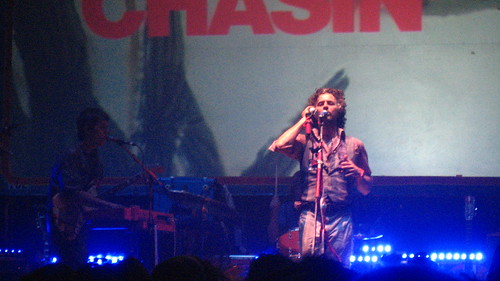
The Flaming Lips @ Hammerstein

Setlist (Approximate):

Race for the Prize//Free Radicals//Yoshimi Battles the Pink Robots I//Yoshimi Battles the Pink Robots II//Vein of Stars//The Yeah Yeah Yeah Song//My Cosmic Autumn Rebellion//The W.A.N.D//She Don't Use Jelly//Do You Realize
A Spoonful Weighs a Ton
You Have to be Joking

I've been prepping for the live show by watching their music video DVD, V.O.I.D. There are two really notable things I take away from it. One is that Wayne looks totally different once the band enters The Soft Bulletin era. Before that he's a generic grunge rocker, but post SB, he takes on an air of mystic importance, and, perhaps coincidentally, the music also takes a quantum leap. The other notable thing is that until Yoshimi, most of their videos were pretty weak. But, the video for the title track off Yoshimi and the US version of Do You Realize make it worth it. This is surprising considering the supreme visual merits of their live show, which lives up to its reputation for inspired wackiness in a really festive, celebratory atmosphere.

Unlike most bands, the Lips set up their own equipment. There's something cool about that, to see Wayne wondering around doing the checks with his fellow bandmates. I've never been to a show at Hammerstein so it was striking just how big the place is. I was still able to get a spot pretty close to the stage, so it worked out fine for me. I don't see why you would sit in the upper level seats in the back, but I'm glad someone did.

The show opened with Wayne rolling around the crowd in the inflatable bubble. It's a very cool visual element, but I wish there was a way to get a mic in there. Following that intro they ripped in to the opening riff of 'Race for the Prize,' a perfect set opener. As the song opened, streams of confetti flew up in the air and balloons appeared in the audience. It was one of the best concert moments I've ever experienced, watching all this confetti hover in the air around.

The whole philosophy of their show is different from most bands. At times the focus drifts away from the music into a spectacle designed to entertain the audience. Listening to Race for the Prize was great, but was really dazzling was what was going on visually around me. This is one of the few bands that I think actually benefits from being in a bigger venue, I don't think some of the moments they pull off could have been replicated in an Irving Plaza style venue.

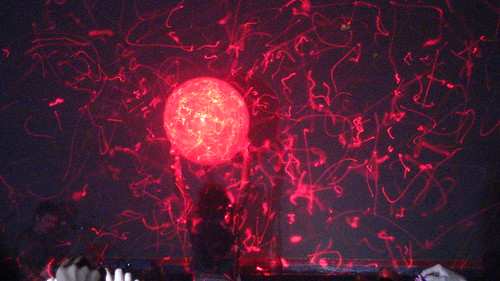
The biggest visual spectacle of the night was the laser light show during 'Vein of Stars.' Everyone in the crowd was given laser pointers, which served as a diversion while waiting for the show to begin. Wayne came out and said to save the battery for the big experiment they would do mid-show. Basically, it consisted of everyone pointing their lasers at a mirror that Wayne was holding. This created a really weird red glow that hung in the air like gas around him. All through the arena was a grid of laser beams, it looked pretty cool, and fit really well with Floyd-y spacerock the band was playing.

During the show, Wayne was very concerned about integrating the audience into the goings on. He was almost like a camp leader, making everyone sing along with the songs. The first example of this was the encore sing along version of Yoshimi after the main one was done. But, the most successful was on 'The Yeah Yeah Yeah Song,' which seemingly had everyone in the audience shouting the chorus back at him. That was definitely one of the night's highlights.

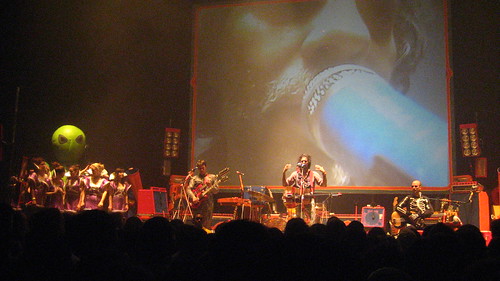
Throughout the show, they used video backing for a number of songs. I really liked the sort of generic spacey stuff they used at times, and the music video excerpts worked well for Yoshimi, but at times I wished they'd stick to the abstract stuff and not use actual video. It was just distracting. However, for 'My Cosmic Autumn Rebellion,' they had an animated story about birds, with the song's lyrics superimposed over. I think it added a lot to the emotion of the song, which was already one of my favorites off At War With the Mystics. After the verses, the band drops this incredible instrumental segment, it's the best moment on the album and worked great live.


'The W.A.N.D' was also cool, Wayne had two strobe lights strapped to his chest, making some crazy visuals to back another great song off Mystics. Even 'She Don't Use Jelly' worked well, with the drums giving a march feel to the chorus. Around this time, the crowd was pointing lasers at a balloon, making a very cool visual effect. Wayne stopped the show and encouraged everyone to point their lasers there. I'm not sure if the laser effects were worth the annoyance of having lasers pointed at you all show, but they were certainly worth doing this once.


The main set closed with 'Do You Realize,' my favorite song of theirs. Again they put the confetti canons to full use, with streamers hovering in the air for the entire song. It was beautiful, the perfect set closer. Following that they did a subdued version of 'A Spoonful Weighs a Ton,' and left again. But, the lights weren't on, so I figured we'd be getting one more song. They came out and played 'You Have to Be Joking,' a song I'm not familiar with, but sounded great, and was a really nice closer to the show.

I'd heard a lot about The Flaming Lips live experience, and I think it lived up to the hype. I think they might have done with a bit less talking between songs, to get a better flow going, but the interaction with the audience was a big part of the appeal, so I guess it's fine as is. The new songs sound great live, and they've kept a good selection of stuff from year's past. There's really nothing like having that confetti suspended above you as massive balloons float above the audience and the band plays fantastic music.

Saturday, September 23, 2006

The Science of Sleep

I've been looking forward to this movie for a long time, and that can sometimes skew your perception of a film. The trailer and publicity material creates a movie in your mind that doesn't always match up to the one on screen. In some ways, this film was exactly what I was expecting, but on the whole, it was pretty surprising. I was expecting something very fantastic in an upbeat way, a journey through the wonder of dream worlds, but what's on screen is a brutally real drama about a man's difficulty in adjusting to the emotional needs of reality. It winds up as an even tougher film than Eternal Sunshine, because in this case, the couple never even gets to have the good times that Joel and Clementine did, rather it's a potential true love that's snuffed out before it can even begin.

When Eternal Sunshine came out, very few people saw it, but in the years since, it's become the go to favorite movie for the college crowd, and a large part of that is the relatability of the film. It may have some weird stuff, but the emotional core of the film has something for everyone. The film has a lot of Gondry in it, but in a lot of ways, Science of Sleep feels like he took those themes he'd already explored and decided to address them in a truly personal context. I hesitate to draw a one hundred percent correlation between Stephane and Gondry, but to me, this felt like the most damning autobiographical film since Fosse's All That Jazz. Both films allow the lead character, clearly a spin on the director, to show off what he's good at, but end up punishing their emotional inadaquecies rather than celeberating their virtures.

One of the central images of creativity is the suffering artist, a lot of people give the impression that you can't make truly meaningful art until you've experienced emotional pain. I think that's true in some respects, total happiness would also mean no desire to move forward and do more. An artist is someone who isn't happy unless he's working on something. As someone who does make films, I find it difficult to see what other people could do to derive the same satisfaction as I get from making films. But, in punishing himself/the character, I think Gondry may be taking this too far. Clearly, this is someone who's at the top of his field, an incredibly respected filmmaker, but the film leads us to believe he's got some guilt about not doing something more real with his life, with spending his time trapped in this fusion of dream and reality. But, is his intention in punishing the character really to punish himself?

All that and I've barely even touched on the film itself. Looking at this film as the followup to Eternal Sunshine, the most immediately notable difference is that the boundary between dream and reality has become much more fluid. Eternal used the memory device as a device to allow for flights of fancy, here the switches between dream and reality are generally unmotivated and sometimes not even apparent. The film immerses you in the perceptory experience of its main character, so that you're never sure exactly what is real and what is just in his head. I think the film succeeds in keeping a coherent emotional arc, so that even though you're not sure exactly what happened at times, you always know how it affected the character.

The opening half hour or so is a bit deceptive in its lightness. There's clearly some sadness in the death of Stephane's father, but it's here that we get the most fun dream bits, as well as the great comedy stuff at the office. I think Guy was hilarious, basically anything he did was funny, most notably his appearance at the club, prompting Stephane to say "He's punk." I liked how the three office workers were the focus of Stephane's dreams, they gave a continuity to the fantasies. The scenes with the stop motion animation going on through the office windows were pure Gondry, a moment only he can do. The cardboard city was a particularly notable visual.

It's with the introduction of Stephanie that we get to the main story. In this film, there's the outlandish dream sequences, but there's also a crushing naturalism to the scenes set in the "real world." Even in the dream sequences, there's a lo-finess that keeps things feeling real. When I saw him speak, Gondry talked about how he didn't want any CG, and I think that was a brilliant choice. The flying scenes were accomplished by having Gael swim with projected backgrounds behind him, and it winds up looking as good as any movie flying scene I've encountered. With most CG, particularly stuff meant to dazzle rather than blend in, there's a tendency to respect it more as good CG than to approach it as something extraordinary and real as the characters do. So, even the best stuff takes you out of the story. The Illusionist is a great example of this, the CG used in the magic trick sequences meant that we couldn't share the audience's astonishment, we're aware of how the trick is done. But, this film uses totally unique techniques that do make you ponder how they did that, but more importantly, are just visually amazing on their own, and those amazing visuals fit perfectly into the realistic world in the rest of the film. It makes it easy to keep minimum separation between the dream world and the real world.

Anyway, the first scene with Stephanie perfectly exemplifies the film's core theme, the idea that this dreamer is too naive and childlike to make it in reality. The two women talk about him while he's right there and delight in messing with him. I'm not sure if he actually doesn't understand, or just pretends not to, but either way, he does nothing to challenge their assumption. Throughout the film, Stephane's childlike qualities are played up, from having him sleep in his childhood bedroom, to literally having his mom move in with him. He seems to be regressing as time moves forward. Guy is in the film as a contrast to this, the ultimate man, someone who happily works his boring job, then goes out at night to find someone to fuck. At one point, Stephane says there's more to life than women, something that Guy would dispute. I think this is also Gondry commenting on the nature of being an artist, he expresses himself through his art, partially because he is too shy to go after girls.

If you watch the "I've Been Twelve Forever" documentary on his Director's Series DVD, you can see a lot of the emotional qualities that inform Stephane here, the conern about having big hands, the invention of wacky things, and most importantly that lack of self confidence that can cause a retreat from reality. There, Gondry talks about a dream he had where he was back in his childhood home, and that may have informed the setting of this film.

In Stephanie, Stephane sees someone he thinks is like him, an introverted, artistic type. However, because he was more interested in Zoe at first, he winds up sabotaging the relationship right at its beginning. He doesn't become aware of his attraction to Stephanie until they start to make art together, in a truly magical scene. I love Stephanie putting the clouds into orbit above them. The cellophane sink is another really cool image. Throughout the film, there's a ton of these small, but very cool moments that help deepen one's immersion in this partricular reality.

One of the best sequences in the film is the bathtub letter part. I love Stephane flying over the town holding the oversized letter, and the book made out of it is great too. But, the most emotionally potent part is Stephane realizing that he really had put the letter under her door, and running to try to get it. I love the way Gondry initially leads us to believe that Stephane has averted the crisis, but later we find out that Stephanie did read the letter, and it informs a lot of where their relationship goes. I think Stephanie feels like Stephane won't be serious about her, he was clearly interested in Zoe at first, and she believes that he will eventually hurt her. So, she refuses to let herself get emotionally attached to him, and they both miss out on the chance for something that's potentially very meaningful.

That's one of the respects where this differs from your typical romance, we're used to the love that can never last, but in this case, it never even starts. It's a bit ambiguous how far along they actually get, but the impression I got was that Stephane and Stephanie were constantly close to a relationship but never actually got to the point of dating. Their first date would have been the meeting at the bar, but it never happened. That sequence was so heartbreaking, we see Stephane's personal doubts, manifested in the dream figures, stop him from actually making it to the bar. In the process, he does exactly what Guy says Stephanie is doing to him. Rather than take the risk of being hurt when she's not at the bar, he decides to avoid that pain and just not go. Seeing Stephanie sitting alone at the coffee house, a moment removed from the subjectivity, is one of the toughest to take because we know then that she was ready to go for it, but he let her down.

Before this, there's a sequence that's rather ambiguous in its navigation of the dream/reality dichotomy, specifically the bit with the calendar debut. I don't think Stephane's calendar actually became a success, but it seems that at some point he did see Stephanie dancing with someone else, causing him to drink. I'm guessing this happened because it's emotionally essential to the film, and we do see her walk into his room wearing the same dress she was in the party sequence.

In the end, it's Stephane's own behavior that ruins his chances with Stephanie. He behaves like a child, asking her to marry him semi-seriously, then getting mad when she dances with another guy. He makes her pony run, but he can't walk into the cafe. He's a character so lost in his own delusions that it becomes an ego thing, he can't escape his own head to really understand someone else. At one point, Stephane says that Stephanie reminds him of his dad. I'm thinking this is part of what motivates his irrational behavior around her. He's the one who's so afraid to go through the pain of losing someone he cares about agian, he either wants her forever, or doesn't want her at all. So, the fear of loss that Guy attributes to Stephanie actually seems to be Stephane's flaw.

Unable to make things happen with Stephanie, Stephane decides to return to Mexico. But before that, we get one final argument between the two. This scene is the most oppressively real in the film, as Stephanie tears into the emotional dream walls that Stephane has built up around himself, and Stephane continually sabotages any progress he's making with his crude humor. It ends with Stephane in the ultimate retreat into childhood, curling up in her bed, refusing to leave. Eventually she joins him, and we segue into one final fantasy sequence. The two of them ride the horse, hop on the boat and sail off.

This is an ambiguous ending, but the feeling I got was distinctly sad. I think Stephanie will tolerate his sadness for a bit longer, but soon she'll throw him out, he'll go back to Mexico and any potential for the two of them will remain unrealized. So, one could read the horse going across the river as any chance of their relationship disappearing. That's the impression I got, just because the emotional and thematic drive of the film didn't indicate any chance of a happy ending. Stephane's behavior just wasn't a point where he could handle a real relationship and Stephanie was unwilling ot risk embarking on one with him.

This is a truly great film that's unlike anything I've ever seen before. The blend of crazy, dream visuals with crushingly real emotion works wonderfully and I think it'll be even easier to get lost in the film's world with more viewings. I was surprised by how similar the film is to Eternal Sunshine, but while that one was primarily Charlie Kaufman with some Gondry, this is all Gondry and it's one of the most singularly personal films I've ever seen. Gondry has taken his life and all his work to date and poured it all into this movie. That may mean a sometime lack of coherence, but it also means a consistent string of visual delights. Add on top of this wonderful acting from everyone involved, grounding the fanciful stuff in an emotional reality. If nothing else, the film proves that Charlotte Gainsbourg will be remembered for more than just Lemon Incest.

The film wasn't what I expected, but it still lived up to my expectations. I'm really happy that Gondry's found a way to transfer the energy of his music videos into a feature format, maintaining the visual inventiveness, but adding a much deeper emotional base. I'm not sure if it's better than Eternal Sunshine, but it's definitely right up there with it.


Related Posts

Work of Directors: The Top 21 (12/13/2005)

Serge Gainsbourg: 'History of Melody Nelson' (4/8/2006)

Reduce stress in the body and begin to dream quickly in only the best
beds
. When sharing a bed with a partner, bed
size
plays a huge role in a good nights sleep. Read some expert opinions on
the importance of bed size
in relationships. You can also find great
baby bedding for the
new addition to the family! Here are some great
baby bedding
and room expenses advice
for first time moms!

Friday, September 22, 2006

Weekend Update

Back in New York

I'm back in New York for the weekend. Tomorrow I'll be seeing Science of Sleep, and on Sunday I'll be seeing the Flaming Lips. I'm really excited for both events. Gondry is one of the most original, visually innovative directors working today and this film seems to be the purest expression of his aesthetic.

The Flaming Lips

I've heard a lot about The Flaming Lips' live show, it sounds like it should be quite a spectacle. I became a fan of the band with Yoshimi, one of the most exuberant records you'll ever hear. I still think it's their best, though The Soft Bulletin and their newest, At War With the Mystics, are both great. The early stuff is a bit more hit or miss, but most of what they've done is pretty solid. I got their video compilation DVD recently. I've watched most of the videos and with a few exceptions, they're not particularly notable. They stick way too much to just having the band playing somewhere and filming it. They're still entertaining, but if the same treatment was done for a song I didn't like, I wouldn't have much as much patience for it. Sofia Coppola's video for "This Here Giraffe" is pretty generic, and lacks the style of her later work. I do love the video for "Yoshimi Battles the Pink Robots," and the descriptions of the videos in the booklet are great, such as this one for "Do You Realise": 'Four bored farm girls lament about how nothing exciting ever happens to them...they get stoned and an apparition of a glowing singing man appears - he is accompanied by giant rabbits with sparkling spheres.' That pretty much sums it up. I do really like having a DVD of music videos around. Sure, you could just watch them on Youtube, but I find I've got a much better attention span if I sit down and put on the DVD, rather than sit at the computer and look at it on Youtube. Hopefully a new crop of director's series discs will pop up soon.

This Week in TV

It's a big premiere week. I'll be watching the season opener for Gilmore Girls, and definitely taking a look at Heroes. I'll also probably sample 'Brothers and Sisters,' if only to see Rachel Griffiths in another show. Her work as Brenda on Six Feet Under is some of the best acting of all time, so I figure her new show at least deserves one viewing. However, from the sound of things, it's got some issues. Look for reviews here.

DMZ

I read the first trade of Brian Wood's Vertigo series, DMZ. I feel like Vertigo is the HBO of comics publishers, they've got a great history of series, but sometimes their new series have trouble living up to the legacy of previous major critically acclaimed, popular works. But, generally speaking, you can trust them to deliver a quality product. I'll sample blind pretty much anything that either of them put out. DMZ has a killer premise, but the murky presentation means that you don't get a full sense of the reality he's trying to present. The art is very much in Wood's own aesthetic, and I can see the point he's going for, using the scratchy art to convey the messy world the characters find themselves in. However, I think clearer art might have allowed us to get a better picture of the world. Wood tells some interesting stories, but I didn't get a character hook. I have no particular reason to care about this main guy, and for most longform series, audience attachment to the character is your greatest crush. Look at Y: The Last Man, it's a glacially paced series that makes a ton of storytelling errors, but the characters are strong enough that I have to keep reading. Here, Wood's writing is competent and politcally charged, but when I finished the volume, I had no particular need to read on. There's no sense of a greater scope, etiher narrative or character wise, and that hurts an ongoing series. Channel Zero had similar issues, and I guess it ultimately comes down to the fact that Wood isn't telling the kind of stories that I might want to read. He's got some great points to make, but ultimately, he's got to be better at something to keep me reading.

Rescue Me

I've been watching more of Rescue Me and I'm definitely starting to get hooked. I've got a better sense of the characters, and I think the show does a great job of showing the difference between their public personas and the private hurt they carry around. And, I think the show does much less shocking for the sake of being shocking stuff than its channel neighbor, Nip/Tuck. There's some weird stuff, but it's better woven into the narrative. I'm through episode seven now, and it's starting to get to the place where I'm watching two episodes in a sitting instead of one. I could definitely see things speeding up as we move towards the end of the season.

Wednesday, September 20, 2006

Top 20 TV Shows

Picking up on another blog trend, here's my top twenty TV shows of all time.

1. Twin Peaks
Best Episode: Finale (2x22)
Best Season: 1


Nothing ever made can match the moody weirdness of the first fifteen episodes of this series. Most shows you remember good characters or an interesting storyline, but with Twin Peaks, it's the atmosphere that lingers with you. After I finished the show, I remember missing the town, like it was a real place, and even now, just hearing the theme song puts me back in that mindset.

2. Buffy the Vampire Slayer
Best Episode: Restless (4x22)
Best Season: 6


I've never been as hooked on a show as I was on Buffy during the fifth and sixth seasons. This show is the perfect example of something that's simultaneously thought provoking, demanding of analysis and thoroughly entertaining. Once you get hooked, the show will define your life for a while.

3. Six Feet Under
Best Episode: 'I'm Sorry, I'm Lost' (3x13)
Best Season: 3


Six Feet Under has my favorite TV character of all time, conflicted lead Nate, as well as the most consistently sharp writing and cinematography on TV. I think the show hangs together perfectly as one 63 episode long story, with the perfect finale.

4. The Sopranos
Best Episode: 'D-Girl' (2x08)
Best Season: 5


The most consistently frustrating show on TV, watching these characters struggle through their lives is sometimes funny, sometimes painful. More than any other show on TV, this one feels like the writers had perfect control of what they're doing, creating a many layered narrative.

5. Cowboy Bebop
Best Episode: 'The Real Folk Blues' (2x13)
Best Season: 2


The moodiest show I've ever seen, this was like Wong Kar-Wai making a series. No other show has used music as well as this, to create singular moments that define the characters. There's subtle evolution of the arc through a series of seemingly unrelated episodes, it's only when you reach the end that you realize how every single piece of the show was building to the catastrophic finale.

6. The Office (UK)
Best Episode: 'Christmas Special II' (3x02)
Best Season: 2


It's simultaneously the funniest show in TV history, and one of the saddest. That's quite an accomplishment, in only twelve episodes, Gervais and Merchant sketch an entire world, then tear it down. The final moments of the Christmas special are some of the most emotionally rewarding in any work of fiction.

7. Angel
Best Episode: 'A Hole in the World' (5x15)
Best Season: 5


The show had a couple of off seasons, that's the only thing keeping it from being ranked higher, because at its best, season five in particular, this stood with the best of Buffy. And, unlike Buffy, they went out at the absolute top of their game, with a final episode that perfectly captures what made the title character so unique.

This makes the end of the shows I would consider masterpieces. After this, there's some really great shows, but they don't quite match up to the preceding shows, which represent the medium at its absoulte best.

8. The X-Files
Best Episode: 'Jose Chung's From Outer Space' (3x20)
Best Season: 3


At its best, The X-Files is my favorite show of all time. There's moments that have a scope and grandeur that eclipse anything else in TV history, but the show will always be flawed by its total disregard for plot and character continuity, and the fact that there were way too many uneven standalone episodes next to the brilliant mythology stuff. But, the show had enough good stuff to remain one of my favorite shows.

9. Freaks and Geeks
Best Episode: 'Discos and Dragons' (1x18)
Best Season: 1


The most accurate depiction of the highs and lows of high school life in any medium. The subtle character development and consistent growth over the season was great to observe, and each of the episodes works wonderfully on its own. If this had kept going, it would probably be much higher on the list.

10. Gilmore Girls
Best Episode: 'A House is Not a Home' (5x22)
Best Season: 5


Like Buffy and Six Feet Under, this show is notable for the way it tracks characters on the journey of life, covering a vast period of time that you just couldn't do in film. The show has gotten slightly darer as it's gone on, sharpening into a still funny, but more poignant exploration of Lorelai's loneliness in the fifth and sixth seasons. Lauren Graham is one of the best leading ladies in TV history, totally carrying the show.

And 11-20...

11. Arrested Development
12. Battlestar Galactica
13. 24
14. Seinfeld
15. Samurai Champloo
16. Babylon 5
17. Spaced
18. The Prisoner
19. Carnivale
20. Trigun

Tuesday, September 19, 2006

Studio 60 on the Sunset Strip - 'Pilot' (1x01)

Aaron Sorkin's a writer I respect, I watched and enjoyed all of his years on The West Wing, and the second season finale, 'Two Cathedrals,' stands as one of the best hours of television ever. But, I'm also aware of his flaws as a writer, a preachiness and tendency to engage in sentimental storytelling. In a show set in the White House, preachiness wasn't as big a problem as it was on his previous series, Sports Night, where a nightly sports recap show frequently turned into a meditation on the resilience of the human spirit. This worked at times, but sometimes it just got ridiculous.

But, I was still really looking forward to Studio 60, if only for a ridiculously stocked cast. This is one of the best network pilots I've ever seen, certainly the most stylish and assured. And on top of that, it even manages to make most of Sorkin's problematic tendencies work for the show. Most shows, even great ones, have some kind of adjustment period, but this one was in total control of its voice right from the beginning.

One of the issues with making a pilot is that your pilot has to set up the show's status quo, but anyone watching the show likely already read a description of it, so we know that Danny and Matt are going to take over the show. So, you're already starting at a disadvantage since the audience knows the basic story of this episode. But, I think there was still a good amount of dramatic tension here, and more than that, the production was so well done on all levels, every moment has something enjoyable about it.

The one major issue I have with the opening sequence, and the show in general, is the fact that TV, for all its reality show excess, is actually in a golden age right now, surpassing any era of previous production and the vast majority of films coming out right now. So the classic "idiot box" rant doesn't really work. That said, the idiot box stuff is only on the surface, the real issue there is with corporate ownership of media and the Christian right's dictation of terms, which is something that's very relevant, so relevant in fact, I'm working on a film about it. So, I can definitely sympathize with that, broadcast television producers should have greater freedom.

The other main issue I've got with the pilot is along the same lines, the fact that these jokes cracking on television just feel old, plus a bit arrogant considering that it is a TV show. It's one thing to say that today's music doesn't live up to stuff from the 60s, but it's pretty clear that TV now is so good, it feels off to crack on it. And besides that, those jokes were already old when Seinfeld did its pilot arc.

Other than those two issues, I loved everything else about the pilot. The West Wing got a lot of attention for its walk and talk scenes, which were lauded primarily from a writing perspective, but were equally remarkable for the cinematography. Tommy Schlamme's fantastic direction is more front and center here, the camera moves are fantastic and he keeps up a fantastic level of energy throughout. I love the neon interiors of the club, as well as the winding shots through the Studio 60 set. Combine that with some really well chosen music and you've got a show with a distinctly cinematic energy and style.

Each of these characters feels remarkably real right from the start. They're not based on archetypes, but the writing just gives you a total sense of who the person is. Matt and Danny seem like classic Sorkin heroes, in the sense that they're idealistic and really believe in doing their job right. I think that's why the chance to run Studio 60 is so irresistible for them, because it's a chance to make something better than what already exists.

Sorkin heroes are a bit like Michael Mann's, in the sense that they have total devotion to their job. There is no personal life, be they the president or sportscasters, life is work. For Mann, this means a gradual dehumanization of heroes, but Sorkin celebrates it, for him, home life is what would dehumanize, one is only really alive when on the job. That's why Sorkin would agree to return to NBC after being dismissed from The West Wing, he can't live without the grind of creating a TV show.

Now, one could say that it's crossing the line to infer that about the man from watching the show, but this series is so obviously based on his own life, it's impossible to seperate the reality from the fiction. And, in the same way that Matt and Danny see Studio 60 as their chance to bring quality to television, Sorkin is doing the same with this series.

I really like the flashier aesthetic of this show versus the staid, reverent West Wing. As I mentioned before, the music gives things a real energy. The moment at the end, when Matt and Danny go out to rally the troops is just like the 'Bartlett for America' moment from The West Wing, and the difference between the soaring trumpets of TWW or the riff from 'Under Pressure' for S60 underscores the difference between the shows. This is a poppier, more fun show. If it can find the same balance between comedy and drama as something like Gilmore Girls, I think it'll be a great show.

The pilot ends on a high note and I was ready to go into the second episode right there. The show may be a bit self indulgent, but it's so good, I don't really care. And if the second episode teaser's any indication, the show's going to go in a great direction. I'll be there next week.

Sunday, September 17, 2006

Beyond the Valley of the Dolls

I really love the 60s mod aesthetic, so much so that if a movie is set in this time period, I can forgive a lot more than I would with the same movie set in the present day. If Beyond the Valley of the Dolls was made about a hip hop girl group in 2006, I probably wouldn't particularly like it, but the combination of period style and Russ Meyer's excess make Beyond the Valley of the Dolls a thoroughly entertaining film.

This is a film that establishes right from the start the schizophrenic, over the top drive that will drive it forward. The opening disclaimer is just weird, and the subsequent images from Z-Man's house don't mean too much on the first viewing, except for the obviously laden image of a man shoving a gun into a topless woman's mouth. It's in the electrifying cut from her scream to Kelly singing that the film grabbed me. A moment that pop gives the film a lot of leeway, and the driving 60s rock in a goofy prom works really well.

This is a film that works in a mode where there's not a clear line between what's serious and what's comedic. The actors play everything totally straight and you can choose to either accept it or laugh at it. I think it's very effective here, and doesn't really distance you from the characters. From a present day perspective, the sheer 60sness of their behavior is endearing. I feel like there's a naivete in their behavior, the thought that what they're doing really could change the world, and that's been crushed out of society following the collapse of everything in the 70s.

The only Russ Meyer film I'd seen previously was Faster Pussycat, Kill, Kill. The title alone establishes that as a piece of excessive pop filmmaking and it lived up to that billing. I think Dolls surpasses Faster Pussycat, more successfully navigating the line between satire and sincerity. The increased resouces of Fox allow him to make a film that feels entirely chosen, whereas Faster seemed to suffer from his lack of budget.

That this film was ever made at a major studio to begin with is quite an achievement. There's some really odd moments in here, one of the most notable being the trip to L.A. montage. This is practically abstract filmmaking, throwing a bunch of barely related images together that become increasingly schizophrenic as time goes by. The oddest moment of the film was the "Bentley, Rolls" sequence, where Ashley is shouting out car manufacturer names while having sex with Harris. It's a moment that transcends reality to become pure cinema. It makes no sense from a human behavior point of view, but in the movie that Meyer created, it wors.

The film is at least partially a musical, and the greatness of the songs really helps the film out. I love 60s pop rock, and all these songs were really catchy. "Sweet Talkin' Candy Man" was a particular highlight, but pretty much every song was enjoyable. I particularly like the editing in the montage sequences, which lays out the characters' emotional conflicts via those dissolves, pitting Harris and Z-Man in conflict. The stark black background of those sequences was striking.

The one plot that dragged a bit was the stuff with Porter Hall. He was likely meant as a satire of the 'square' community, but the stuff with him and Kelly was a bit obvious. That said, the scene with the two of them in bed was pretty funny.

There's a lot of quotable lines in the film, the best being "This is my happening and it's freaking me out!" The whole opening tour of Z-Man's house is full of stuff that's so 60s and so Russ Meyer. I think there's something endearing about the vision of this sexually liberated utopia presented in the party, there's something innocent about that compared to today's club or frat party scene, which is so focused on predatory behavior.

As things wind on, we build up to the predictable reconciliation with Harris. I didn't find Harris a particularly likable character, I think his conservatism doesn't fit with the general embrace of Z-Man's world. I suppose his rejection of Ashley for Kelly could be read as a satire of the values conventionally undermining this sort of story, but you have to do a bit more to be a satire, now it was just indistinguishable from those films. That said, I think the moment where they're all set to go rescue Casey and have to take the time to load his wheelchair into the car is absoulutely brilliant.

Casey herself becomes part of the really bizarre ritual that ends the film. The film just keeps building and this final bit definitely feels like they were making it up as they were going along. That's not necessarily bad, you can appreciate this as a bizarre moment all its own. Before that, we get the surprisingly underplayed abortion scene with Casey. You wouldn't see that today, another indication of the turn towards conservatism in our society.

At Z-Man's, Casey and Roxanne dress up as Batman and Robin and go through a series of visually crazy rituals. This leads up to the two parallel homosexual scenes and ultimately Z-Man's madness. I was surprised to see a generally progressive view of homosexuality in the film, at least until Z-Man is revealed as a crazy transvestite, nothing too progressive about that. The ending has such crazy energy you can forgive the logical inconsistencies. One of the best moments is Z-Man cutting off Lance's head with the 20th Century Fox fanfare in the background. I was surprised by the fact that he ended up killing Roxanne and Casey, the really brutal violence intruded on this otherwise cartoonish world.

Eventually Z-Man is defeated and we get a really odd narration to wrap things up. Likely put in to appease the studio it winds up as a mockery of the sort of moral closure it was intended to provide. Lines like "Roxanne and Casey's love wasn't evil, but evil came about because of it" are just impossible to take seriously. The final moments, where Kelly helping Harris over a river bed are equally ridiculous. I'm not a huge fan of the triple wedding final scene, which is either hopelesslly saccharine or way too over the top to even be funny.

But the bizarreness of that closing narration is what lingers, summing up the odd worldview of the film. This is a movie that's so full of energy, you can watch any moment and enjoy it as a piece of fine 60s pop art. I love the music, I love the visuals, this is a thoroughly entertaining film that I would highly reccomend checking out.

Weekend Update

Blog Upgrade

Earlier today I upgraded to the new version of blogger. I don't think that'll make a big impact on the way it reads, but there are some new features that have potential cool. I'll try to put those to use.

INLAND EMPIRE

Last week I successfully got tickets for the October 9th screening of Inland Empire at the New York Film Festival. The film's gotten a mixed reception from its Venice screenings, it sounds like Lynch is taking the more subjective cinema he developed in Lost Highway and Mulholland Dr. and is pushing it even further. Watching Mulholland, I've always wondered what it would be like to have a film that was all like the post box chunk of that movie. Considering Inland is three hours, that could be too much of a good thing, but I trust Lynch. If Fire Walk With Me was outright booed at Cannes, while Wild at Heart won the Palm D'Or, you've clearly got to take festival audience reactions with a grain of salt. I think that's one of the big problems with the festival scene, one bad screening for a movie like Inland or The Fountain, with 500 people in attendance, can multiply into a lot of bad buzz before release. Luckily I'll be going in pretty much clean for this screening. I've only seen a couple of photos from the film, so the visual experience will be totally new.

The TV Season Begins

This week sees the debut of the new show I'm most looking forward to, Aaron Sorkin's Studio 60 on the Sunset Strip. I'm also going to take a look at Jericho, a post apocalyptic drama. I want to try to see more shows from the beginning, recently I've been waiting for a show's buzz to build before sampling the first season on DVD, but I really enjoy the week to week viewing of a great show, and hopefully something this season will make it. I've already been watching Weeds and Nip/Tuck. Next week has the premiere I'm most looking forward to, the start of Gilmore Girls' seventh season.

Nip/Tuck

After two episodes of Nip/Tuck, I'm getting closer to dropping the show. I think this season is an improvement over last year's hyperabsurdity, but the show is really suffering from the fact that it's based on shock value rather than character development. There's not that much left that they can do to top what's already happened. I'll be surprised if the show is able to maintain even this quality through the season.

New Music

I listened to the Scissor Sisters' new album this week. The first single "Don't Feel Like Dancing" is classic, and there's a few other good tracks, but it had a bit too much semi-country flavor. I prefer the shiny club aesthetic of the first album, but admittedly, that's after one listen, it's always tough to follow up on a near perfect album like the Scissor Sisters' first. I also listened to Outkast's Idlewild album, which I was pretty impressed by. It got knocked around by the critics, and I would concede that it lacks the cohesion of Stankonia, but there's a lot of really good songs in there. That said, I would like to see them drop one more really good album together. And the album that's still impressing is Justin Timberlake's FutureSexLoveSound. The production is unbelievable, Timbaland and Timberlake are like Wong Kar-Wai and Tony Leung, the perfect match of creator and performer.

Toronto Film Festival

The TIFF seemed to have so many films playing, it's hard to keep track of major trends out of the festival. Reaction to The Fountain seems much the same as it was at Venice, but I'm still confident in the film. In certain art film circles, there seems to be a reluctance to engage with material that doesn't have a layer of irony over it. If Little Miss Sunshine got the most buzz out of Sundnace, it's pretty clear that festival audiences don't always have their priorities straight. Part of the problem is that seeing so many films means you're probably exhausted and will prefer a zippy comedy to a slower paced, challenging film. Buzz on Kim Ki-Duk's Time is mixed as well, it seems to be a return to the darkness of his earlier work. That should crop up on Region 3 DVD pretty soon. I've already got Pen-Ek Ratanaruang's Invisible Waves on the way. I was shocked to see that the star of that film, and his previous, Last Life in the Universe, is the same guy who was in Ichii the Killer, Vital and Funky Forest. He seems to dominating Japan. The other film that sounds really cool from Toronto is Miike's Big Bang Love: Juvenile A, which sounds really experimental. I've got some more Miike in the Netflix queue, he's a filmmaker I've really got to see more of.

Upcoming Dates of Note
9/22 - Science of Sleep Released
9/24 - The Flaming Lips at Hammerstein
10/9 - Inland Empire at NYFF
10/20 - Marie Antoinette Released
10/25 - Seven Soldiers #1 Released
11/22 - The Fountain Released

JLA: Earth 2 and Wrap Up

Last time, I wrapped up my writing on Grant's main JLA run, but now it's back for one more with his graphic novel, JLA: Earth 2. During the main JLA run, Howard Porter's art was generally satisfactory, but nothing too special. So, it's a big jump to the greatest artist working in comics today, Frank Quitely.

The thing I love about Quitely's work isn't so much the aesthetic as the way that his art creates near three dimensionality. This is really evident in his work on New X-Men, and his work on the final issue of The Invisibles makes me wish that he could have drawn the whole series. Of course, if he did it probably still wouldn't be finished. Anyway, his work here isn't quite up to the level of that or We3, but it's still very strong.

One of the themes that cropped up every once in a while during Grant's run on the series was to take the story necessity of having the JLA always win and make it a feature of the universe in which they live. The best longform works are able to the take repetitive story elements necesitated by the form and turn it to the story's advantage. In Buffy, this meant that her attraction to Spike wasn't a retread of Angel, it revealed the fact that the character required some darkness in her mate. With the JLA, it becomes a meta comment on the very nature of superhero fiction, and Earth 2 is concerned with exploring this idea by creating a world that's the opposite.

In Warren Ellis' works alone we must have seen ten different analogues of the JLA, so the idea of yet another crop of JLA dopplegangers popping up isn't inherently that exciting. But, Morrison pushes things to the next level by creating an entire alternate universe that reverses the metafictional rules governing DCU storytelling.

I've gained a lot of affection for the DCU from reading this JLA run and Seven Soldiers, but I'm not a big enough fan to grab all the allusions that Morrison makes in building Earth 2. The first half of the story is so devoted to building up the anti-matter verse that it takes until about halfway through the story to really take off. The best stuff in the beginning is the humor surrounding the illicit relationship between Owlman and Super Woman. The petty humanity of these characters is such a contrast to the godlike JLA. When the JLA finally cross worlds, they're disgusted by the very nature of the world.

My very Quitely page is the big shot of Green Lantern building hands around the moon. That's flashy, but throughout we see Quitely bringing a level of detail that you don't normally get. The panels with the many, many Flashes are particularly impressive. I think Quitely's greatest strength as a storyteller in doing moments in detail, so the constantly moving narrative of this book doesn't necessarily work to his strengths, or rather, it doesn't take full advantage of his possibilities.

Reading this book now, one of the striking things is the rampant destruction of major buildings. Grant's JLA work, and most of the widescreen superheroics it inspired, are of a distinctly pre 9/11 mindset. There's some death, but this destruction is generally treated as a light thing, just a salvo in the war. I think if the book came out today, you wouldn't see this sort of thing. All of Morrison's work from this period has an optimism about the direction of humanity that feels somewhat undermined by the stuff that Bush has put us through post 9/11. I think he still feels humanity's going in a generally positive direction, but right now, the forces of progress are losing the battle with the archons. That's why The Filth is such a critical work in Morrison's cannon, it shows the dirty flip side of this shiny optimism.

We soon find out that Brainiacis behind this cross of worlds. Brainiac stands outside the manicheanism of the JLA/CSA. As he says, he is "Beyond good and evil. Beyond the moral and conceptual framework which limits 3rd-level intellects such as your own." He is such a high level intellect that he does not care that his actions will result in a lot of people dying. Morrison's work frequently focuses on moving beyond traditional conceptions of morality, which makes it a bit hard to reconcile Brainiac as a villain. I thin Brainiac is meant to show a pure intellectual being, whereas in the supercontext, it is love for humanity that motivates the push to higher levels of intellectual consequences. Without that emotional grounding, evolution becomes a destructive force.

The thing that I love about the book is the way it can be read from the matter or anti-matter perspective with equal validity. You get a real idea of the morality of the CSA world, those characters feel totally real and motivated, and you can see how our world would be weird to them. Throughout the book we see the actions of the two groups balance each other perfectly to fit the nature of their worlds. In our world, good will invariably wind up triumphing, so the CSA's destruction is quickly repaired, in the same way that in the other Earth, the good that the JLA does must be undone. Each world must always revert to its status quo. In that way, this work provides the best explanation for why heroes in the DCU are always going to win. But, if you were a reader for the anti-matter verse, you could just as easily read this book as a triumph for the CSA.

So, like a lot of Morrison works, this book functions simultaneously as a meta comment on superhero fiction and a fine example of the form. I would still consider "Rock of Ages" the ultimate Morrison JLA arc, but if you want a condensed idea of what's great about the run, go to this book.

And that brings me to the real end of Morrison's JLA run. Before doing this read through, JLA was one of the rare Morrison works I wasn't a big fan of. This read has changed that, I think his treatment is the definitive address of these characters, he made the big seven more than their mythology and brought real humanity to the large supporting cast. Seeing Green Lantern becoming more confident and revel in his heroism was really satisfying, and Huntress' uneasy move into and out of the group was the most grounding emotional force in the narrative.

Reading all of Morrison's JLA back to back makes you forget just how innovative his stuff is. The fill in issues sprinkled throughout the volumes bring this to the fore, Morrison's work is so far beyond what anyone else is doing, in terms of narrative, character development and concepts, I hesitate to see why anyone would read it after he left the title. Obviously there's love for these characters, but only when Morrison writes them do they feel real, other people just draw on the same couple of traits that they've been whiddled down to over the ages.

Looking through the run, my favorite arc was undoubtedly Rock of Ages. This arc took the kitchen sink approach, throwing everything in. The JLA fought robotic doubles of themselves, battled Lex Luthor and The Joker, went to Wonderworld, and reset the world from a dystopia ruled by Darkseid. I loved that arc because it felt most like his work on The Invisibles, there was more uniquely Morrison in there than anywhere else. I also loved the two issue storyline featuring Daniel from Sandman, an arc which functioned as a simpler version of Flex Mentallo. One Million was in a lot of ways the high point of the run, full of so many ridiculous concepts and a narrative scope that was never matched. Earth 2 and the final issue are also notable.

The run's greatest demerit is the somewhat repetitive structure of most arcs. A foe appears who has figured out a foolproof plan to defeat the JLA, he winds the first round, then the JLA regroup and beat him. Because most of the characters have individual titles, you can't really do heavy character arcs, so these massive scope narratives are pretty much the only way to make a viable threat.

Looking at this run next to Morrison's work on New X-Men reveals a lot about the difference between Marvel and DC. The characters in X-Men are designed to be actual people, they have flaws and are meant to be people the readers can identify with. The core members of the JLA are aspirational figures, so they're frequently read as power fantasies. However, Morrison goes beyond that simple interpretation and positions the JLA as humanity's guides to the next stage of evolution. As Metron says at the end of WWIII, the JLA shows us a glimpse of our future selves, and it's up to us to get to there.

The Complete JLA Review Index

JLA: New World Order (#1-4)

JLA: American Dreams (#5-9)

JLA: Rock of Ages (#10-15)

JLA: Prometheus Unbound (#16-17)

JLA: Return of the Conqueror (#22-23)

JLA: One Million

JLA: Executive Action (#24-26)

JLA: Crisis Times Five (#28-31)

JLA: World War III (#34-41)

JLA: Earth 2

JLA: Classified (#1-3)

Thursday, September 14, 2006

Manderlay

The first Lars Von Trier film I saw was Dancer in the Dark, and I was really bothered by it. But, I'd heard good things about Dogville, so I decided to check it out and was overwhelmed by how good it was. My main criticism of Dancer in the Dark was that the lead character was so acquiescent to her fate, just accepting all this punishment and not reacting to it. That's why the end of Dogville is so powerful, because it totally messes with the idea of the suffering melodramatic heroine.

So, Dogville was great and I was excited to see Von Trier's followup. Manderlay is a very challenging, thought provoking film that's one of the most biting films made in recent times. Even more than Dogville, it's is a direct attack on American policy and belief, both conservative and liberal.

The film's opening shot, with the zoom in on the perfectly white map is striking, particularly the transition into action down on the stage. The style here is basically the same as Dogville. I read a couple of reviews that talked about how the style was a distancing device. I don't know if that was the intention, but for me, the stage setting drew me in a lot more than it would have if this was shot on a real plantation. What the style does is reduce the film to the essentials, the few important props and the actors. Stripping away the excess makes the story more timeless, and because the intention is to create an allegory, that's critical.

Some of the stuff that happens in the film is disturbing and could easily be misinterpreted as racist if taken out of context, or even in context. I was uncomfortable watching some of this, but I think the film has an intelligence that makes it clear that it's working on a satirical/metaphorical level, not a literal one. It also means that the characters aren't necessarily going to be developed or behave in the way you'd expect from a traditional film. Some of the dialogue is a bit stilted, but I don't really mind that. The stage setting gives Lars the freedom to create something less real, a world where Defoe can give a speech like the women and savages part and have it work. You could read it as bad acting, but I think the stilted delivery works in this world.

Nicole Kidman was fantastic as Grace, but I'm not sure if this film would work as well with her in the lead. The physical resemblance between her and Lauren Bacall would have driven home the thematic point about habituation of systems, but Bryce Dallas Howard's naive youthfulness brought a lot to the role. Plus, I think it would be difficult to accept the fact that Grace, who wiped out an entire village of people at the end of Dogville, could be so self righteous here. Howard pulls off a lot of difficult stuff and keeps the character grounded in this odd world.

If you read this film just as it plays, it's got a message that's a bit difficult to accept, the idea that slaves don't really want freedom, they prefer having someone to blame for the bad things in their lives. That's the sort of message you'd expect from something like Birth of a Nation. However, what makes the film so much more is the way that Von Trier shows you how systems of power perpetuate the ill treatment of disadvantaged people. When Grace arrives, she sees a fully functioning society that is morally abhorrent to her. From her perspective, the slaves are victims, so cut off from the world that they're not even aware that they should be free. She brings that freedom and expects them to immediately leave the mansion and start new lives.

I'm not sure how much Von Trier thought of film to film continuity when making this, but it would seem that Grace's experience in Dogville informs a lot of her actions here. There she was essentially made into a slave, hated it, and ultimately took revenge on the whole town and reclaimed her freedom. She was a freeperson made into a slave, and was unable to accept that lifestyle. She was vindictive about having something taken away from her and lashed out at the town with the power her family possessed.

So, she is coming from an experience where she could use her power to reclaim her freedom. That is totally different from someone who is completely powerless and also no idea of what it's like to be free. If you've spent your whole life as a slave, with a strict routine, freedom would be a terrifying unknown. Some of them may have dreamt about being free of Mam, but they're not prepared when that dream actually come true.

Von Trier's basic point with the film is that systemic oppression creates a class of people who are dependent on the oppressor and unable to function on their own. This obviously applies to freed blacks after the Civil War, who lived in a society that granted them freedom, but would not offer them real opportunities to support themselves. They had no choice but to revert to the same kind of arrangement they were living in in slavery. Most of these people were born into slavery, so they lacked the experience with which to run their own lives.

So, the slaves turn to Grace, their liberator, or rather, Grace takes charge of this aimless band, and tries to show them how to be free. Here is where she begins to run into problems. For the system to work, it requires the labor that was provided by slaves. So, what she's doing is putting them to work at the same jobs, just now with the chance to reap the rewards of their own harvest. However, those rewards are off in the distance, for now, they work without anything to distinguish this labor from slave labor.

Von Trier's scenario applies equally well to any sort of institutional system. Prison is a great example, once you go into prison, it becomes very difficult to return to life in mainstream society, the routine of prison becomes ingrained.

But I think the most potent interpretation is to read the film as a critique of US foreign policy, particularly in Iraq. Grace, like the United States, has high minded ideals and believes that it should work to free these imprisoned people from the rule of a cruel dictator. However, saying someone's free does not make them free. Freedom is a choice someone has to make, you can't force it on them, and it's the same with democracy in Iraq. Bush's greatest hubris is the idea that you can spread democracy by force, and Grace does the same thing, she says she wants people to be free, but winds up controlling them, just until they get to freedom. It's the same in Iraq, people become dependent on the US military in the same way that they were previously dependent on Hussein.

If we're to look to the future, Von Trier indicates that following the failure of US involvement in Iraq, the Iraqi people will turn to a new dictator and the previous status quo will be returned. There's also clearly a mocking of liberal arrogance here, liberals love to talk about "the people," but when it comes time to actually deal with them, they're usually a lot less affectionate.

I think the film does a great job of dramatizing the steps that the plantation takes on the way to its new form. Both this film and Dogville do a wonderful job of showing the evoultion of community, there's none of the typical montages to skip through things, rather Von Trier takes his time to show us processes at work and make us as invested in their success as the characters are.

Grace tries to create a democratic government, but in bringing it about, she takes on a level of dictatorial power. The authority that her gangsters provide allows her to force people to come to the town meetings. In theory, freedom should mean that the meetings are optional, but she is sacrificing temporary freedom to get more down the line. Her governing strategy blows up when the people vote to kill Wilma. So, democracy is good, unless the people choose to do the wrong thing, that's what she seems to think. This moment raises the issue of whether she did the moral thing by killing Wilma. Should she have instead tried to lobby the people to be more lenient in their justice? This bit ties into the end revelations about Mam's Law. Because there's so many of the slaves, they always have some power over their master. Their numbers mean they have the ability to force Grace into doing something she doesn't want to do.

The major subplot in the film revolves Grace's lust for Timothy. Here, Von Trier, is juxtaposing the simultaneous attraction/repulsion that an upper class woman like Grace would have to an African man. She doesn't see him as a personality, rather he is a collection of traits that she casts onto him, something that's made explicit when she finds out that he is a Type VII, chameleon. Grace generally holds herself above the slaves, and is disgusted by her own feelings. This reinforces Grace's arrogance, she feels perfectly fine running these people's lives, but would never think of actually loving one of them. This fits well with the way that Grace's fancy clothes and high class demeanor separated her from the salt of the earth Dogville folk.

When they finally do have sex, Grace is essentially used, her face obscured, she's an object for Timothy to fuck. So, things have flipped, and rather than Timothy being the object, Grace now is. Grace's feelings cause her deep shame, and when she's whipping Timothy at the end, it's as much about punishing herself.

About that ending, the successful harvest is a great payoff because we've been with these characters for so long, living their struggle, so we get the vicarious joy of their success. I think Dogville was more successful at creating strong individual characters within the community, but here we get a strong sense of the community as a whole.

This leads into the big revelation about Mam's Law. The slaves have chosen security over freedom, and for them, it makes a lot of sense. They get food regardless of the harvest's success and always have someone to blame for the problems in their life. The film is a critique of this victim mentality, but makes it easy to understand why these characters choose to live this way. Basically, the US government let them down by failing to provide any viable options for their post-slavery existence. That means the best they can do is try to maximize the possibilities of their current existence. What they need Grace for is to serve as the locus of their blame. If they don't have a Mam, there's no excuse for their problems. This is the system they've had for all their lives and no one wants to leave that security.

Grace whipping Timothy isn't quite the cathartic hellfire of Dogville's finale, but it's still very powerful. Here we see the character taking the frustration of her months on Manderlay and putting it into one burst of violence. In the end, the film seems to indicate that systems create cycles and it takes more than surface change to alter peoples' behavior.

I think Manderlay is a great, great film, but it doesn't quite match up to Dogville. Part of that is the style was fresher and more surprising in Dogville, but also that the supporting cast there were much stronger characters. Here, Grace is more clear, but the others exist more as pieces in a scenario than real people. Plus, the finale of Dogville was astonishing.

But that doesn't mean that this isn't a fantastic movie. It's interesting both on its own terms, and as an extension of the themes in its predecessor. I really hope that Von Trier does fiinish the trilogy and make Wasington, but if not, this still stands as one of the most inventive, politically aware series of films around.

Tuesday, September 12, 2006

JLA: World War III (#34-41)

At the end of the final issue of Morrison's JLA run, Metron says "We have shown you the shape of the world to come. Now you must find the way there." That basically sums up Morrison's goal with the series, and with most of his work, to prevent an aspirational model of the humanity that could be. For him, the superhero is a vision of what humanity could be, the next step in evolution, and that concept is at the center of this arc.

I think the final issue is fantastic, but the earlier stuff is a bit more hit or miss. I do like the way Morrison brings back some old villains, which gives a nice sense of closure to the arc. It's like everything has been building to this point, which is true in some respects. However, the arcs are generally standalone so the payoff in this final arc isn't going to be the same as it is in The Invisibles, or New X-Men, where each arc built on what happened previously, bringing us to a big overall conclusion at the end.

One of the issues with writing for the JLA is it becomes very difficult to keep topping yourself. I feel like One Million was the ultimate threat for the JLA, and since then the smaller arcs actually worked better, where the focus was on character rather than just making massive foes. In this case, Prometheus and Luthor are good villains, but they seem to be here only to show how massive a threat Mageddon is. Side note, but I'll just mention that the Bee Queen seems like a precursor to The Filth, with both her visual design and the nastiness of her setup.

Mageddon works better as a thematic villain than as a an actual foe. He's a concept, and can create destruction, but we don't have a huge emotional stake in his destruction. That said, when you're dealing with the JLA, normal villains don't work. What they're fighting in Mageddon is the destructive force of regression. It is a holdover from a previous world and is trying to destroy the world that has grown up since his time. So, it's the ultimate conservative force, the anti-sun, an impediment to human progress. In this respect it's similar to the Sheeda, who harvest civilizations when they grow too powerful.

Morrison heroes are always about evolution, so Mageddon is the ultimate foe for them to fight. During the arc, there's a lot of different phases of evolution. What we realize by the end of the arc is that the whole reason the New Gods were working with the JLA was to fight Mageddon. They were there to guide humanity through this trial then leave them to grow on their own. If we view the New Gods as humanity's parents, this arc is all about humanity proving that it's strong enough to stand on its own.

However, humanity here is divided into two distinct categories, regular human and superhuman. The New Gods serve as parent figures to the superhumans, and the superhumans act to guide the regular humans. This series has been all about the way that these God like beings have the mandate to inspire regular humans to be better.

The ingenious thing that Morrison does at the end of the arc is reveal that Mageddon is literally preying on humanity's primal, unevolved weakness by activating our dormant reptilian DNA. Side note, but it was great to see Animal Man back in a Morrison comic. I think Morrison gave the character the perfect conclusion to his own series, but it's nice to get to see him just keeping on. Similarly, it's cool to see Zatanna as well, I would love to see Morrison write an ongoing series with the character, his work on her miniseries was phenomenal.

Anyway, if Mageddon's going to fight them by targetting our primitive weakness, the JLA decides that the best way to combat this is to tap into humanity's potential and evolve the world. On the one hand, this feels like territory Morrison has gone over many times, but I give him a pass because it works wonderfully here. I love the idea that the JLA is giving humanity a preview of what they could be. Morrison's core thematic statement is contained in this speech by Oracle:

"Hi, everyone...don't be afraid...what we're feeling are new structures opening up in our brains...It's like a preview o evolution. All this amazing stuff you're seeing and feeling is what Superman feels like all the time. It's why he wants to save us."


That sums up the whole series right there. The JLA are the ultimate form of humanity, what we hope to be. In a panel right out of Flex Mentallo, but still potent, we see an army of ordinary people flying up to battle Mageddon because they want to thank Superman for saving them. Juxtaposed with this is Superman's crisis of faith while figthing Mageddon. It's this tribute from ordinary people that gives him the strength to absorb the energy of the anti-sun and defeat Mageddon. It reminds me a bit of Buffy's "The Prom," where we see that ordinary people really do notice what these superhumans do for them. It's a really powerful moment that perfectly expresses so much of Morrison's personal philosophy.

For him, superhero comics are a way to examine humanity's future and construct a model of what we want to be. Having the ordinary citizens become superpowered is the equivalent of the reader being brought into the comic to fight alongside the characters. Batman mentions that the JLA always end up winning, and the way the ending is structured implies that it's the reader's faith in the characters that ultimately gives them the power to triumph over evil. On a literal level, the fact that we keep buying the books and seeing the movies means that the characters remain viable properties and there will not die. So, reading the book does keep them alive.

Reading a lot of Morrison JLA can numb you to just how strong his ideas are. But, if you step back, the torrent of crazy concepts in this final issue is unmatched by virtually any other author at any time. And by this point, you just accept it because he's built a world where all this is viable, it's a world where imagination and strength of belief are enough to win the day. Look at Green Lantern, he just has to believe and his ring works again, it's not the ring that matters, it's his belief in the ring.

The series ends with humanity having received a preview of the world it can one day have, and Metron giving the JLA the goal of bringing that world to fruition. One day everyone will be like Superman, and in the world that Morrison's created, great power does not corrupt, it allows you to see the wonder of the world. The bad guys in this series are the ones with petty, individual concerns, the good guys are the ones who can transcend that to fight for the good of the world as a whole. And in the final panel we get one more meta nod to the reader with the hilarious line, "We're the Justice League. You know you love it."

I once heard someone say that Morrison always has problems ending his series. That's absoultely ridiculous, Morrison's endings usually do a wonderful job of wrapping up the loose ends of the series and providing a vision of the characters' future. Animal Man #26, Doom Patrol #63 and The Invisibles #1 are three of the best comics you'll ever read. JLA #41 isn't on that level, but it's still a thoroughly satisfying wrap up to a great run.

Ultimately, World War III suffers from fatigue. By this point, it's very hard for Morrison to surprise us. So he probably made the right choice by exiting the series then. However, the final issue is a wonderful topper to the run, perfectly articulating the thematic concerns that made his work so unique. It was an issue that had me cheering.

Next up, I'm going to do a wrap up of the run as a whole. So, look for that in the next couple of days.

Saturday, September 09, 2006

Weekend Update

New Music

I've listened to a few new albums this week. One is The Cocteau Twins' Victorialand. The Twins are a band I've heard mentioned a lot and have always been meaning to get around to listening to them. I finally did and I really enjoyed the album. It's very ethereal, a less rocky predecessor of Sigur Ros. It's one of those bands with a really unique sound, perfect for a film soundtrack. I also listened to Justin Timberlake's Future Sex/Love Sounds, an album that's really successful, if a bit long on the first listen. The album is so now, with a great dirty electronic vibe. Timbaland's production is fantastic and I think he and Justin succeed in pushing him beyond the territory of Justified. A lot of rock bands never get beyond making the same album over and over again, and I'm glad to see Justin experimenting and pushing things a bit.

Not Yet Rated

Last week saw the release of the documentary This Film is Not Yet Rated, which has drawn a lot of attention to the MPAA ratings system. I actually don't have a major problem with the ratings system, the issue I've got, that isn't mentioned in any of these articles, is the fact that the NC-17 rating just isn't commerically viable. The whole point of the rating was to try to separate artistic films with explicit content from pornography, yet, because so many people won't advertise/show the films, the NC-17 just isn't commercially viable. Rather than trying to change the MPAA, I think the best idea would be to force theaters to show NC-17s, and make it like the X originally was, back when Midnight Cowboy, an X rated film, was able to win the best picture Oscar. How can this be done? Well, a lot of it goes back to America's puritanical morality, and there's an implication that you shouldn't be watching NC-17s. But, if a studio put out a legitimately good film, that also had popular appeal, with an NC-17, perhaps an audience would show up. Personally, I'd love for the rating to catch on so I don't have to deal with kids at screenings. A major issue is the fact that studios always target kids, so the NC-17 can be market death.

Grant Morrison Quote

I was reading this fairly recent interview with Grant Morrison, fascinating as always. Anyway, the interview has a quote that I love:

And think about the emotional experience of reading comics. Nothing but ink on paper , right ? Yet people fall in love with Jean Grey and threaten to commit murder in her name! People cry when Ted Kord gets shot dead! As we all know, inert drawings and words on a page can produce an absorbing, often addictive, unfolding illusion of life, movement and even personality but surely the reader's 'experience' of the 'story' in a comic is actually a hologram - a virtual reality generated by the overlapping of multiple human consciousnesses - 'creator' consciousness interfacing with 'audience' consciousness through the medium of print.


This touches on a lot of the themes that I got out of his work back in 2003 after I read The Invisibles, the idea that fiction is just as real, if not more so, than our so called reality, because it can create actual emotional responses in people. I love that Morrison is thinking so much about the very nature of the medium, you just don't see this sort of examination in film, and where it is, it's bogged down in Academic babble. Morrison has ruined college for me in some respects because his pop! philosophy puts academic writing to shame. The Invisibles not only tells you about the nature of the universe, it also tells a great story. You're not going to get that from a traditional philosophical text.

Rome and Rescue Me

I recently watched the first episode of these two series. Rome was pretty good, certainly the production values were amazing, but it suffered from the same problems as a lot of period pieces, namely a lack of relatability to the characters. There was a lot of potential though and I could see this being quite good once they get the cast sorted out. Rescue Me felt very much like a typical 00s cable show pilot. It was really well made and easy to watch with strong character drive right from the start. My major issue was the too cliche dead cousin talking to the main character and the fact that I just don't usually like stuff set in those really macho all male environments. But, I'll give this one some more episodes too. Neither completely grabbed me, but they both feel totally watchable.

Upcoming Dates of Note
9/22 - Science of Sleep Releated
9/24 - The Flaming Lips at Hammerstein
10/8 - Inland Empire at NYFF
10/20 - Marie Antoinette Released
10/25 - Seven Soldiers #1 Released
11/22 - The Fountain Released

Friday, September 08, 2006

Splendor

The journey through Gregg Araki's filmography comes to a close (for now) with Splendor. Every successful indie director usually reaches a point where they are offered a mainstream project, and the success of this project will determine whether they "sell out" or continue in the indie world. Splendor certainly isn't your everyday romantic comedy, but it's so toned down from the excess of The Doom Generation and Nowhere that it can't help but feel like a stab at mainstream success. This is like Dazed and Confused after Slacker, or Mallrats after Clerks, a film that takes the director's idiosyncracies and fits them into a more mainstream form, in this case the romantic comedy. For Linklater, doing a mainstream film actually helped curb some of the excesses of Slacker and made for a fantastic, albeit unprofitable, film. Splendor is more like Mallrats in that it feels like Araki made some concessions to the mainstream that ended up blunting that which was so unique about him. Splendor isn't a bad film, it's just one that that's not particularly unique.

That said, the first half hour or so is very successful, and very Araki. The Halloween club scene, with intense blue light, is right out of The Doom Generation and Veronica is like a female version of James Duval's characters in those films, naive, yet full of strong desire that will drive her through the film. I really like the device of Veronica speaking directly to the camera. For one, those shots are gorgeous, with the ethereal white background and rings of light in her eyes.

Tracking back a bit, it's interesting how Araki uses near identical openings for all his films. We usually start on a white background with white letters on top, ethereal music playing as the camera pans down to a scene. I love the opening shots here, and the way the white soon fades into purple, it's fantastic visual stuff.

A film like The Doom Generation is notable for its complete visual assault on the audience. But, as Splendor forges ahead, we get less and less of visual interest. The opening club scenes give way to a rather standard domestic scenario, becoming more and more mundane as the film goes on. I'm guessing that the opening visual intensity is designed to disguise the fact that what we're watching is essentially exposition, but I'd rather watch this interesting exposition than the plot stuff that happens later.

The plot itself is at once transgressive, in its basic conceit, and totally ordinary, fitting the mold of countless romantic comedies. When the film begins, we're presented with a love triangle with no easy resolution, two guys who each have their own unique merits. When combined as one, they become the perfect guy, the fusion of physical and mental prowess serving as the ideal mate for Veronica. I found this pretty interesting, the troubles they have trying to navigate life as a threesome. I think there was more potential for comedy there, particularly in putting them in contact with more 'normal' social situations, maybe bringing in a character who knew Veronica back in her suburban home, directly contrasting her old life with her new.

Though I suppose that role was filled by Ernest. Ernest is a classic romantic comedy character, the nice guy who seems perfect for her, except for the fact that she doesn't love him. Once he enters the film, things start to descend. I was still emotionally involved in the story, but I wasn't really sure how to feel. On the one hand, Veronica doesn't love him, but at the same time, the story goes out of its way to make Ernest seem like this perfect guy, it feels a bit cruel for her to string him along then dump him. It's a bit of a cliche to make the romantic rival into a jerk, but that's done for a reason, because it makes it easier for the audience to get behind the heroine dumping him for the guy she really loves. In this case, the two guys seem so slackerish and unproductive, and Veronica so dissatisfied with them, that it's hard to accept that she has a deep love for them.

But, that's what the story's about. I think the ending is particularly troubling, with the really goofy jumping off the hotel balcony bit, which feels like a much different film. This, for all the goofiness, had a generally real world feel. But that final stunt felt like something out of an Adam Sandler movie.

In the end, Veronica's decision to embrace her alternative lifestyle ties directly in to Araki's central theme of people growing up and leaving behiind the repressive power structures of generations past. This is dramatized in a crazy way in The Doom Generation, and also represented in the totally out of touch parental figures in Nowhere. But it feels the most like Mysterious Skin, where Wendy has to choose between staying in Kansas and growing up to live her parents' life or heading for, and embracing the big city.

The film has most of Araki's thematic and stylistic tropes, but they're shoehorned into a conventional romantic comedy structure that really limits him. Mysterious Skin does a much better job of moving out of the hyper style of TDG and Nowhere and into more sedate, 'mature' filmmaking without sacrificing his visual style or narrative ambition. But, Splendor was a necessary step along the way.

Looking ahead, his next film is Smiley Face, a stoner comedy, which could be another attempt to move into the mainstream. He could play it as an over the top insane journey, a la Nowhere, but I'm guessiing it will be more restrained and conventional. Will this be successful, and more importantly will it be good? I'm still hoping that he gets Creeeeps going, that one's been talked about for a while, but doesn't seem to be making much forward progress.

Thursday, September 07, 2006

Veronica Mars: The Second Season

A while back, I watched the first season of Veronica Mars, which I liked but didn't love. However it was enough to get me to watch season two, a season that solves a lot of the problems I had with the first season, but still has a bunch of issues of its own. I don't think the show has made it to greatness, though it's always entertaining.

The major place that this season improves on the first is in the episode to episode continuity. Back in season one, there was some character development, but the focus of most episodes was on the stand alone mystery of the week, with some development in the Lily Kane case going on in the background. Here we get a lot more subplots and development for the secondary characters, and much like second season Buffy, it becomes a serial show, where there's sometimes a standalone plot as well. Generally speaking, the standalone plots have a thematic tie in to what's going on in Veronica's life.

This season, the overall mystery, the bus crash, was usually a secondary plot element, weaved in to the tapestry of events going on in the characters' lives. On the one hand, this works because less of the season's success is reliant on the progression of the mystery. However, I think the fact that the bus is made up of a bunch of characters we don't know means we can't sympathize with the town's initial sadness at the crash. I do like the way they gradually develop the people on the bus, particularly in the dream sequence heavy episode with Veronica imagining she's on the bus. But, by the point we get to know these people, the initial impact of the event is gone, so we never get an emotional jolt from what happens.

This ends up causing problems when we get to the season finale. Because of the show's structure, we can never get a clear villain. It's a world where everyone's a bit nefarious, but not until the final moments of the season can Veronica have a clear antagonist. This causes a bunch of narrative issues when they try to turn Beaver, the goofy, troubled kid we've known all season, into a dangerous, menacing figure. Because we've been pulled through so many theories and loose ends, the actual revelation of what happened is rather underwhelming. The extent of the investigation seems to reveal that the actual person responsible for the crime doesn't particularly matter, the kids are still dead either way.

So, they have to make Beaver more than just the guy who blew up the bus, and this leads to one of the most uncomfortable plot decisions on the show, to say that Beaver raped Veronica when she was unconscious at the party back before the show started. Technically, this fits with what we've heard before, but it just doesn't make sense with the character we've seen, and it comes across as a really crass attempt to make Beaver come across as a villain. Plus, it just pours the misery on Veronica a bit thick, to think that she was forced into sex by two guys in that one night. Come on, that's a bit excessive.

In the case of this show, it's really the journey more than the resolution that's fun. Some shows are designed to build up to the season finale, most of Buffy or Six Feet Under, each season working as a coherent chapter structured to climax in the last episode. Veronica is like that, except the resolution here just didn't work for me. For one, the piling on of atrocities didn't quite fit with the tone. The Woody Goodman molesting children thing in particular was tough to match with Veronica's quip happy persona.

Because Veronica is such a caustic character, it's difficult to emotionally relate to her, and this means I don't get engaged in her pain in the same way that I did with someone like Buffy. She always remains cynical about things, and that makes it difficult to fit the Woody Goodman stuff, or the episode about the college rapist, into the show's world. I think it's good that they tried to branch out into heavier stuff, but it takes a lot of skill to move between a rape and comedy, and I don't feel like that episode was able to handle it that well. Plus, the Woody Goodman stuff came across as a retread of Mysterious Skin.

However, despite all this, I still really enjoyed the season. It just goes by really smoothly, the cliffhangers make it easy to back to back an episode and I liked a lot of the expanded cast. Dick Casablancas in particular was always hilarious and I'm hoping he'll make it back next season. Charisma Carpenter was interesting, playing someone who's basically Cordelia if she'd never met Buffy. The dialogue was always snappy and I loved the continuation of the Aaron Echols storyline. I just wish he hadn't gotten offed at the end of the season, it'd be great to see him and Veronica continue sparring.

So, this is one of the shows that's always entertaining, a lot of fun to watch, but lacks the intellectual cohesion of a truly great show. I'll still be watching the third season, and hope that the show does get a bigger audience now that it's paired with Gilmore Girls.