Wednesday, August 22, 2007

Timbaland: Today's Beatles

I'm listening to Timbaland's Shock Value for the second time right now. It's a strong album, not quite as effective as his work with Justin Timberlake and Nelly Furtado last year, but it's seventeen weird, but catchy songs like only he can make. At this point, Timbaland is so ubiquitous, and just so fucking good, he's creating songs that are critically respected and beloved by club kids, hip hoppers and elitist indie hipsters. His work transcends boundaries in a way that reminds me of very few artists before, one of the most notable being The Beatles.

The Beatles have become something of an institution, they're so good, it's barely worth talking about them. What can we really say that will add to what's come before? Perhaps a little something. I think of the most notable things about The Beatles is the fact that they were simultaneously the most groundbreaking band in the history of recorded music and the most popular. That happens so rarely, in film and literature, it always seems to take a few years for people to catch up to the really good art. Spielberg is probably the closest thing film has to a Beatles, but he's much more mainstream and traditional than The Beatles were.

The genius of The Beatles was their ability to experiment so much within an accessible form, the three minute pop song. Part of the reason they've been so analyzed is the layers within the songs, the many instrumental tracks and subtle details. Like a lot of great artists, they seemed to be positively running over with ideas, leading to songs like "A Day in the Life," which fuse together two potentially good songs into one great one. Listening to Rubber Soul or Revolver is intimidating, to hear just how many now classic songs they stacked, one after the other. Virtually all their songs have become part of our collective culture, everyone just seems to know every Beatles song, you can't say that for other very respected bands from their era, even massively popular ones like Pink Floyd or Led Zeppelin.

While there certainly isn't a direct correlation between popularity and artistic credibility, I think it's important to look at music's place in our collective consciousness. While I may love some Daft Punk songs more than ""One More Time," if I was in a club, I'd rather hear "OMT" than " Face to Face" just because it's what people know. There's nothing like hearing people cheer when a song is dropped, and a song has to have a certain level of popularity to reach that point. That's why it's important that we still have mainstream radio, or some kind of media through which songs can become widely popular. Without that, we lose our shared culture. Part of the reason that 80s songs are so ubiquitous today is because everyone knows them, and you can't say that about most bloghouse tracks. I'd imagine a large part of why people go to concerts is just to be with a bunch of people who know the same songs and love the same band, it's the collective experience as much as the performance.

The 90s was a downtime for pop music, a lot of bad songs were wildly popular. Now, there's always going to be bad songs that go over, but there's very few popular 90s songs that were actually good. So, I've been really happy to see pop music resurge in the 00s, thanks primarily to two producer teams, The Neptunes and Timbaland. These two put together a list of incredible songs that were both great songs and incredibly popular. The Neptunes have slipped off the radar a bit, but looking at the songs they were involved in earlier this decade is astonishing.

But, this past year, Timbaland has surged ahead, with an unprecedented dominance of radio and the pop culture music space. Most of this is his work with Nelly Furtado and Justin Timberlake. It's been amazing to watch Justin go from middle school girl icon to one of the most respected men in music, largely because his work with Timbaland is just amazing. The album has spawned five singles, and there's still a bunch of strong tracks in the wings. It's so rare that a song become both incredibly popular and get such strong critical response, but "My Love" did just that, getting love from everyone.

What does it all mean? Basically, I think it's important that we have a collective musical experience to draw on as a culture, and I'm glad that Timbaland is making it such a good one. He's making the best and most popular songs, and dominating things in a way that The Beatles did before him. Artists may say they don't want to be popular, or it doesn't matter to them, but I think ultimately all of us want people to love our art, only some artists are most willing to make compromises to do that than others. I pride myself on making the movies I want, but it's tough to watch people respond to a mainstream comedy more than my stuff. What I want is for people to love the movie I want to make. I'm not quite able to do that yet, but with music, Timbaland is. It takes a little bit, but already, his solo album is spawning a bunch of hits. "The Way I R" hooked me, and it's getting better with very listen. I'm really glad to be part of a time when an artist like Justin Timberlake can get the respect of everyone, that we've moved past the idea that being popular, or being pop, is equal to selling out.

Tuesday, August 14, 2007

John From Cincinnati: The End is Here

I was expecting it to happen, but it was still sad to see that John From Cincinnati has not been asked back for a second season. This may actually be the first HBO drama to not get a second year, and considering how fast this choice follows the finale, it doesn’t seem like HBO was laboring over the decision. I felt like the show was gone after the initial critical salvage, and the weak ratings for the premiere. HBO relies on a critical chorus to make their shows into something that people have to watch. In the absence of that, people didn’t have any reason to check the show out.

There’s a wide variety of reasons for the show’s failure to get a larger following, but ultimately, it all goes back to The Sopranos’ final moments. At 9:58 on June 10, Tony looked up, a screen went to black, and that show was over. People were furious, claiming that somehow they were “owed” an explanation, a “real” conclusion to the story. They apparently didn’t look at the rest of the episode, which resolved all the narrative issues of the season, as well as the lingering tension between Tony and Junior. No, life goes on wasn’t enough, they needed to hear exactly what happened.

I was wiped after the last Sopranos, and didn’t actually watch the John debut then, and I don’t think I’d have reacted well had I watched it immediately after the enigmatic final moments of The Sopranos. But, after a break, I saw episode one and enjoyed it. I never felt the show was anywhere near as impenetrable as people claimed it to be. There was weird stuff, but there were character and narrative hooks to keep you going through that. Not everything should be explained in the first episode of a show, and not everyone’s purpose need be immediately clear.

But, throughout the show’s life, I’ve read countless posts where people ask for answers, and wonder if everything will eventually be revealed. Considering the way Milch works, there’s not likely a master narrative plan in place, rather it’s a series of ideas that are developed through the characters. If you understand the central ideas he’s exploring, it’s not that tough to contextualize the “random” events of the show. Even when there’s not a clear narrative drive, the formation of community formed the backbone of the series and gave a thematic lens through which we could understand everything that happened.

Who is John, where did he come from and why is he here? Milch is only really interested in one question, the why. What does knowing exactly where John comes from tell you that you don’t already know about the show. He’s from some higher plane with a mission for us. That’s what matters, and I think that’s plenty to understand the show by.

But, I’ll admit that it’s a show that takes work. If you’re not willing to think about what you’re seeing and bring parts of yourself to the show, it’s not going to work. I love works that leave room for the viewer’s input. Hollywood filmmaking is all about tying up loose ends and leaving you with a perfect little box. This show is a mess at times, but it’s a mess you can get lost in, become a part of. Much like Grant Morrison’s work, the show needs you to fully realize it. It’s a starting point for the viewer to work from. We are like Dwayne and Jerri in the final episode, watching these events on a monitor, but also involved in them in some way. That’s the beauty of television, the way a world can emerge over time.

I’m probably going to go back and do a larger thematic wrapup, but for now, here’s a bunch of links that provide interesting reading on the series. Probably the most important is this interview with David Milch, conducted yesterday. He talks a lot about the show, the themes underlying it and the process he used to make it. It helped me fill in some gaps, and certainly gives a context for what we see on screen. But, this isn’t a case of us needing the explanation to understand the show, it’s all there if you look for it.

He says something really important here: “Whether we choose to or not is up to us, and so why surfers? Surfers are because my show - "Deadwood" was canceled, inexplicably to me. The suggestion was made to me, why don't you do a show about surfers? Young, masculine, that's the demographic. Can you do that and have it engage your own spirit? "John From Cincinnati."”

So many people were mad at the show for “replacing” Deadwood. Once and for all, this makes it clear that Deadwood was cancelled, it was stopped without his consent, and his choice was either make JFC or make nothing. The thing that baffles me is why HBO continually blurs the line here. I suspect their goal was to make the cancellation of Deadwood easier, by focusing on how Milch was moving onto other projects, but this backfired by alienating much of the Deadwood fanbase. Their recent comment that the Deadwood movies and a second season of JFC was an either or proposition was another huge PR mistake. If they really wanted to help the show, they should have said, great ratings for JFC would be the best way to get the Deadwood movies made, even if it was a lie. I get the feeling HBO’s current management had little love for JFC, and just wanted it to go away.

So, to everyone who keeps bitching about Deadwood’s cancellation and blaming JFC for it, that’s not the case. And, I’d argue that JFC is a far better show. It’s much more unconventional and intellectually challenging. I dug Deadwood, but JFC was working on a different level from practically everything else to ever air on TV.

Another great link to check out is the Inside the Episode features over at HBO.com. They give a lot of insight into Milch’s process, and provide transcripts of crucial scenes, like John’s speech.

To me, the show was a huge success, and I would have loved to see more, but I think it ended in a good place. I see this as the end of John’s initial mission, to save the Yosts. In the process, he created an army around him, people who will spread his message. That group that grew over the course of the series will go on to influence others and his change will gradually infect everyone’s mind. One could argue that the show has done the same thing, got these ideas out there where they can influence people, and now it’s up to us to keep pushing them. First step, does anyone know where I can get one of those Stinkweed shirts?

More to Come! A more analytical look at the series is in the works and will be up later this week, and thanks so much for all the positive blog comments, it's great to know there's other people out there who like the show and are engaging with it in the same way I am.

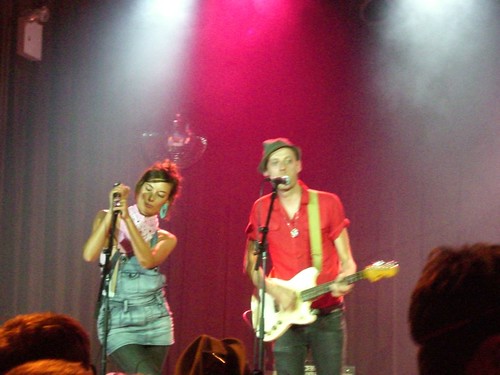
Junior Senior @ Highline Ballroom

Setlist (Courtesy Fluxblog)
Go Junior Go Senior / Chicks and Dicks / Dynamite / Good Girl, Bad Guy / Rhythm Bandits / Happy Rap / Itch U Can't Scratch / We R The Handclaps / Can I Get Get Get (with JD from Le Tigre) / Move Your Feet / Shake Me Baby / Shake Your Coconuts / Hip Hop A Lula // Trust Tissue / White Trash

Junior Senior’s first album was a strong, fun bunch of songs, but their second album, out today in the US, is a masterpiece, each song a three minute pop masterpiece, flowing seamlessly from one high point to the next. So, I was eager to see Junior Senior in action, nearly two years after first hearing the album, and I was not disappointed by what they brought.

But, before they went on we had the antics of the gayest band in the world, Gravy Train. That’s not a judgment, it’s just the undeniable truth. They reminded me of a less skilled Scissor Sisters, amplifying the stage antics and removing any of the emotion. Scissor Sisters are a band who use theatricality to enhance their music, while these guys are just theatricality. I have no particular desire to see them again, but it’s rare you see people actually talking about an opening act, and nearly every review of the gig I’ve read has spent at least some of the time discussing them.

Before getting into Junior Senior, a quick rant about set start times. Now that I’m working, it’s a real hassle to stand around for two hours after the stated start time, four hours after door open, waiting for the band to start. The stage crew was done setting up by 10:40, and we just there for twenty minutes, waiting. This can really kill a gig, particularly when you’ve got to get up at 7 AM for work the next day. Last week’s free show from Cansei de Ser Sexy was ruined by the fact that they went on at 1:15, by that time all the momentum that was building was gone and we were just a bunch of people standing in a sweaty room. This wasn’t so bad, and my annoyance was pretty much erased by their energetic performance, but still, I’m assuming most of these people work, is it that tough to move things along?

Anyway, once Junior Senior emerged, things took off. Most of the band came out, a guitar, a bass, two backup singers, Junior and finally Senior, who looked like a giant European version of Eminem. This was a really tall guy, particularly when standing against the tiny dude from Le Tigre. He had phenomenal stage presence. Even though Junior probably has more musical talent, it’s Senior’s stage presence that puts the band over the top as a live act.


In a radical departure from nearly every other concert ever, I was pretty annoyed by the initial bombardment of old songs, and was almost ready to yell out “New album!” by the time they finally dropped “Happy Rap.” It’s not that the show wasn’t working well, those tracks got the audience into it, and “Rhythm Bandits” in particular was a highlight, but the new album was such a jump, I was hoping to hear more from it.

When they finally did play a new track, it was my least favorite, “Happy Rap.” Now, this was a situation where least favorite is the optimum phrase, pretty much every track they played rocked the audience and was tremendously entertaining. This is infectious, ecstatic music and that comes across in the live show. I was just grinning throughout the whole show, it was so much fun. Next up was “Itch U Can’t Skratch,” which owns right from the opening synth descent. That song has a great hip hop style bounce dwelling under the poppier main part.

The highlight of the show was “We R the Handclaps,” which featured amazing guest vocals from their backup singer. Not only was she ridiculously hot, she had a voice that reached way up, hitting notes I heard on the album, but found hard to believe were sung by a human voice. She absolutely owned this song, already one of the best off the album. I only wish she could have gotten a chance to take on more of their songs, particularly “Take My Time.”


The rest of the show provided a bunch of highlights. “Move Your Feet” was fantastic as expected, the interplay between Senior and JD on “Can I Get Get Get” was a lot of fun, and the closing stage rush for “White Trash” was a great finale. If the band was this fun and strong with Junior’s voice in recovery, I can only imagine what they’re like at full strength. This show was a great followup to Daft Punk, another blast of infectious dance music. I hope they pass through here again, and give us more off the new album. That’s really the only complaint I’ve got. Where were “I Like Music” and “Dance Chance Romance”?

Monday, August 13, 2007

John From Cincinnati: 'His Visit: Day Nine' (1x10)

The season, and likely the show is over, and if this is the way we go out, I’m pretty satisfied. It’s a finale that resolves some central questions, but leaves us with a lot to talk about in the years to come. If the end of The Sopranos tells us anything, it’s that questions draw more attention than conclusions, and considering so much of the joy of the series is in its mystery, I’m glad we’re left with some things to ponder. I thought I had figured the whole show out last week, but this week left me with some open questions. Still, if you follow the basic thematic template of the season, most of what happened does make sense, and is a perfect thematic wrap up to what we’ve seen over the course of the season.

But, themes and complex ideas aside, the opening of this episode is pure filmic adrenaline, the real climax of the series and an absolutely exhilarating moment. We open in the clouds, music building, then slowly descend onto the water to reveal John and Shaun flying across the water. I really can’t say enough about how incredible that moment was, the entire opening sequence was complete joy and put a huge smile on my face.

From a narrative point of view, last episode was the darkness before this wonderful dawn. It was a test of faith and the three foremost believers: Kai, Butchie and Cass, all passed the test, waiting for John and Shaun to return and being rewarded by the vindication of their faith. This obviously has some Jesus parallels, but unlike Jesus, there seems to be no limit on Shaun and John’s return, their absence was not about suffering themselves, it was more about helping those around them to fully come together and work as a family and community.

Everything is restored and for the first time in a while, the whole family is reunited. Shaun says that it’s time to move out of his grandparents’ house, to be with Butchie and John. At the beginning of the series, Mitch and Cissy were constantly insulting Butchie for his failure to be there for Shaun. This came out most heavily after he didn’t show for the surfing contest where Shaun was injured. Cissy and Mitch take it as a criticism that Shaun would want to leave, but I think it’s more a reflection of Butchie’s growth.

It’s also significant if you view Shaun as part of the healing trinity, with John and Zippy. Butchie claimed that it was only the presence of Shaun that kept Mitch and Cissy from spiraling off the deep end. He was there to heal them, and now that work is done. The rift with his mother is healed and he can move along. Throughout, Shaun has been a healing and unifying force. We see this in his behavior with his mother, always being affectionate and opening the door for her to take a larger role in his life. The character frequently seems passive, but he is instigating a lot with Tina, and that has helped to heal her.

As I mentioned last week, one of the series’ essential themes, and the key to understanding this episode, is the notion that John is there to heal all the characters. They’re all carrying around past sins that have crippled them, and he is the catalyst for events that will allow them to move past the pain and reinvent their lives. In this episode, Cissy finally accepts Tina, and secures her a place in Shaun’s life. This helps her move beyond the guilt she felt for leaving Shaun so many years ago. It was the healing of Shaun that set this possibility in motion back in the second episode.

Concurrent with this, we’ve got the lengthy sequence where Linc interrogates John, and John tries his best to convey his father’s message. This is where things started to get a bit confusing for me, there are elements that I can’t reconcile, and may not be reconcilable with the material we’ve seen. After all, the show has not been cancelled, and Milch has to leave something open for a second season. But, a lot of what he says here does clear things up. The first line of his speech, repeated here, “If my words are yours, can you hear my father?” clicked for me when he said it. It builds on what Butchie and Kai were talking about last week, that he repeats what we say to represent concepts he doesn’t have words for. He uses our words to tell us about his father. That’s a central piece of knowledge to help understand what he’s doing throughout the series.

Much of this dialogue consisted of a revisiting of the speech, explaining some of what he said there. But, things are a bit more ambiguous when you consider what he says may actually mean other things. I’m particularly wondering about what Cass’s camera means. It could obviously refer to her camera, but is there a larger significance? The way I’m seeing it now is that Cass’s camera is a metatextual reference to the filming of the show. So much of the episode was shown from the perspective of her camera, and it was piped into the internet café in a way that was technically impossible.

In the café, Dwayne and Jerri are made into viewers of the exact same action we’re watching on TV. It would make sense to use Dwayne as an audience surrogate, for the viewers who are on the internet trying to figure out what’s going on. If Cass’s camera is the world of the show, then is Dwayne the fanbase surrounding it? Is the internet big because that’s where the show lives on and develops? One could easily interpret ‘his visit’ as a visit to us. Every week, we check in with John and these characters, existing on the fringe of their world, seeing it only through a camera, like Cass does here. She seems to have lost her own self and taken on another persona, something that would be possible once she’s aware that she is creating the world around her through her camera. Notably, all of the things that John said would happen in Cass’s camera in his speech, did happen on the show, in one way or another, supporting the notion that it’s a metatextual reference.

If we read things that way, does it explain who John’s father is? I don’t think Milch is breaking the fourth wall to say that he is the ‘Father’ who gives John words. That would reduce John’s mission to something that’s only relevant in their fictional world. I think the ‘Father’ is God, or at least some pure essence of goodness from which all things flow. John is his messenger, speaking for him without knowing exactly what words to use. The idea of his father having a father is a question you could ask about God, and is not something that’s easy to answer. If you read the scene as John being a messenger from God, then his inability to answer questions makes sense. That’s not something that our words are capable of doing, it’s an idea that’s bigger than any of us.

The greatest ambiguity of the episode for me is the nature of the car dealer. He speaks in the same way as John, using a lot of the same language. The implication is certainly made that this man could be John’s father, which would explain why John took them there to buy the car. The other explanation, and the one that I’d argue makes more sense is the notion that John’s message is spreading. Last week we heard other characters making reference to “big” and “huge” events. This could be symptomatic of a larger change, even people not directly connected to the family are speaking the way John does. During the parade sequence, the groundwork is certainly laid for an expansion of John’s message, and that seems like the most fertile ground for a potential second season.

One of the things I like about the episode is the way that it brings everyone together. Earlier, I assumed that Linc and Tina would pose a threat to Shaun, but it turns out that they, and Jake Ferris, are working in his best interest, just in a different way than the others. Linc’s exploitation of Butchie was the catalyst for all the Yosts’ problems at the start of the show. This is something he makes explicit in his speech. I was wondering why that speech was going on so long, and it wasn’t until after that I realized why. He had not faced up to being the source of so many problems, here he does, and he also hands over the company to John and the Yosts, letting them take control of their own destinies. We finally get that happy family tableau that was first glimpsed during the speech, things aren’t perfect, but they’re ok.

Tracking back a bit, the entire parade sequence was a bit out of nowhere, but fits with the oddness of the show. The best part is Bill’s outrage after he’s arrested while trying to coordinate traffic. The parade serves as a celebration of John’s message, and something of a coming out party for his agenda and the family in general. The critical thing here is the fact that Stinkweed has been turned into an engine for spreading John’s message. His symbol, the line and circle man, seems to be part of something larger. It is his sigil, and through it, he can spread his agenda.

Now, this may be projection, but I feel like the next step in John’s agenda if forming a kind of army to help spread his message. That’s the reason he comes back in fatigues, and also why there are the constant terrorism references when discussing his mission. Cissy continually refers to him as like a terrorist. It would make sense that God would send his own warrior to counter those who kill in his name, only instead of fighting with violence, he fights with love.

I think the show is largely centered around an examination of what it would be like if Jesus came to Earth today, and using that framework, it would make sense John would use a major corporation to spread his message. He converts his disciples, and by putting his logo on everything, he will help to spread the message. Last episode, we saw one stick man becoming two becoming many. That is what Stinkweed will do for John, rather than selling the bad boy image, they will sell the ultimate good.

The one misstep of this episode was the Freddie and Palaka storyline. While I’ve loved the constant character additions, at this point, we really didn’t need a lengthy scene with two people we hadn’t seen before. The storyline took up too much time, and didn’t feel as urgent or exuberant as the rest of the show. But, I do like the resolution, in which Freddie gets out of crime, inspired by the events he’s witnessed over the course of the series. That fits in perfectly with the themes of the series and the journey the character has gone on over the past few episodes.

The final scene of the episode has Bill finally confronting his demons and going upstairs for the first time since his wife’s death. It’s a wonderful scene, no one can do monologues like Ed O’Neil on this show, and it also marks the resolution of his character arc. This great pain he’s carrying around is finally on the way to being healed. His journey is similar to Barry’s, they must confront a space that horrifies them, and when they finally go in there, they realize it’s not so bad, and are free to move on with their lives. The return of Zippy is a wonderful moment, Bill had to prove he could do things without Zippy, and now that he’s succeeded, Zippy can return.

But, there’s still some major things to ponder. In the brief, 16mm style sequence, we get another voiceover from John that’s just baffling. I think the point is to give us a final blast of weird information to keep us pondering. The most odd thing is first, that Dr. Smith goes to Cincinnati and comes back twenty years younger. This raises a question about what Cincinnati is. When he returns from the water, John says that he came back from Cincinnati, and Shaun says that he only remembers what they wanted him to say. The opening sequence, and the logic of the show, suggests that Cincinnati is heaven, where John’s father resides. So, it’s possible that somehow Dr. Smith wound up there and came back younger. Smith was the first person to be dazzled by what happened to Shaun, and it would make sense that he would receive a special reward from John’s father.

The rest of the speech is as follows: “Cissy gets knocked up. She's bigger than Leona Helmsley. Earth puts Dickstein on retainer; Daphne keeps his head straight. Jerri meets a slew of new hairlips. My father forewalls (four walls?)Barry's bar. Dr. Smith trains Dwayne and Ramon. My father freelances in Cass' camera."

I’m not sure what the significance of Cissy gets knocked up is, but Leona Helmsley was renowned for being mean, so it would make sense to associate the character. Perhaps he’s saying that she has moved on and is now “bigger” than Leona, in the sense that she has more important priorities. I couldn’t tell you.

Earth puts Dickstein on retainer would seem to relate to his mindblowing, and just blowing, experience earlier in the episode. Something happened there, which ties back to a comment John made in the pilot about the significance of the lawyer getting a blowjob. So, he has been given a new path, the universe has spoken to him and put him to work. I’m not sure what forewalls, or four walls, means in this context. It’s a place where John’s father seems to have a major influence, but I couldn’t tell you what exactly is going on. Dr. Smith training Dwayne and Ramon would mean that both of them will work to help heal people.

The idea of his father freelancing in Cass’s camera is an interesting one. If we continue the metatextual reading, it’s arguable that his father could be appearing in various guises throughout the series. That would reinforce the idea of the car salesman as John’s father. What is definitely clear is the fact that God is present in various moments of the characters’ lives. That what Dr. Smith and Barry referred to last week, his ‘freelancing’ is what helped them to get the clinic and bar going, the “hallelujah chorus” that Smith referred to.

And what of Mitch’s levitation. I read online that it’s meant to be a metaphor for his distance from his family. It certainly works on that level, John made him to levitate to show how he’s losing touch, and at first, he wants them to leave, not pull him down. But, eventually Butchie and Shaun do, and the family is healed. I love the moment where they’re all united cracking on the guy who yelled at Tina a few episodes ago. I also love the fact that he returned, further tying the community together.

One more lingering enigma is the Chemist. He seems to be in touch with what’s going on, and when he stares out at the stadium thing, he knows that’s where the message is coming from. He’s the only one with the perspective to recognize what’s right in front of them all.

And at last, we come to the initially baffling final moment, a shot of Cass and John’s narration: “Mother of God CassKai.” Now, this is a tough one. John has equated Cass and Kai previously, as has Cass herself. I would argue that the reason he calls them the mother of God is that they are the first two women to follow his teaching. So, they will birth his God out into the world. We previously saw them equated during the end of last week’s episode, where they’re both watching Butchie out in the water, waiting for Shaun. They each have had contact with John and each have “seen God.” They are the people John confides in, and are best able to understand him. Each grow frustrated by him at some point, but ultimately are in awe of his abilities.

This episode shows John taking the first step in spreading his mission to a larger world. He has saved the Yosts, and they shall be his representatives, but the ones who had faith in him from the beginning were Butchie, Shaun, Cass and Kai. They are the core, and that is the reason that CassKai is the mother of God. That said, why is this the end of the show? We’ve spent so much time talking about John’s father, it would be logical to address the mother. Both have seen God, via John, so they shall carry him out into the world. He showed no one else that vision, they are special. And, it is through Cass’s camera that his word is spread out to us, the audience of viewers parallel to their universe.

From here, John will spread his message, and if there is another season, I’d imagine that will be the focus. After all, we are all one larger organism, and more people need to realize that. When they saw God, it was other people, so why not save the entire universe?

Will there be another season? I don’t know, I’d love to see it, but all we can do is hope. If this is the end, it went out on a fantastic note, and I feel satisfied with the ending. All the major plot and character threads are resolved, but the door is open for more. This series has been a masterpiece, leaving me in awe every week, and now that it has wrapped the season, I can confidently say this one of the best pieces of art to ever air on television, and I want to thank everyone involved in making it for bringing something so uniquely powerful to our world.

Saturday, August 11, 2007

Babylon 5: Ten Lost Tales that Should Be Found

While I enjoyed Voices in the Dark, the stories that JMS told there weren’t exactly ones I, or anybody else, was clamoring to see. He has such a rich universe, it’s a shame that all the TV movies, with the exception of In the Beginning concern themselves almost exclusively with generally unimportant events. Now that the door has been opened for more films, here’s a bunch I’d actually be interested in seeing, in chronological order.

1. Valen and the Previous Shadow War: For All of Michael O’Hare’s crappy acting, the character got a wonderful sendoff, and found a really interesting place in the backstory of the series. But, there’s still a lot of open questions about Sinclair and his life in Valen. I’d love to see a big movie that covered the previous Shadow War and showed Sinclair/Valen’s role in it. He’d get to hang out with Kosh and we’d also see how Sinclair adjusted to life with the Minbari. Through his prophesies, we could get a bunch of tie ins to the series, and I’d love to see the Shadow War rendered in today’s CG effects.

2. Morden, Anna and the Shadows: This would be tough since the actors have aged, but I’d love to see a movie that showed what happened to Morden and Anna Sheridan when they met up with the Shadows during their expedition. How were they converted, did they legitimately come to believe in what the Shadows were doing or was brainwashing involved? This would be ideal for a smaller scale project, perhaps paired with a story of Lyta on the Vorlon homeworld.

3. Garibaldi and Bester: At series’ end, one of the big question marks is what Garibaldi did to Bester. Now, I’m aware this was covered in a canon novel, but it’s not the same as seeing it presented visually, with the actors involved. So, I’d love to see what happens when Lyta lifts the mental block and Garibaldi gets the chance to seek revenge. Knowing JMS, he likely realizes that killing Bester wouldn’t get him anything, but it’d still be interesting to watch. There’s a lot more inherent drama here than in a random standalone story.

4. Lyta and the Telepath War: A lot of the post series material seems to indicate that Lyta is dead. But how did she die, what would be powerful enough to take out someone with her psychic capabilities, and what did happen during the telepath war? These are all questions that linger and have been convienently avoided in post series material. Lyta was just coming into her own at the end of the series and I’d love to see her at the height of her powers in a Dark Phoenix set against a war backdrop story. This would be a big one, but if they can do In the Beginning on a TV budget, this should be doable too.

5. The End of Crusade: Admittedly, this’d have a more limited audience, but I’d still like to see a movie that showed how the Drakh plague was resolved, and also gave some resolution to the characters from Crusade. Everyone wouldn’t have to return, but get Gideon, Dureena, Matheson, Galen and perhaps Sheridan in there to show what finally solved things. I’m sure JMS had the idea in mind, so it’d just be a matter of reassembling everyone.

6. Lennier and Delenn: One of the great ambiguities at the end of the series is what happened to Lennier. He died at some point between the end of the show proper and ‘Sleeping in Light,’ but there’s still a lot of untapped drama there. This would also give Delenn a chance to do a story that’s more than just a greatest hits tour. Did Lennier completely lose it after ‘Objects at Rest,’ or was he forever plagued by conscience, trying to atone for his great mistake?

7. Dureena and Galen: While I wasn’t a huge Crusade fan on the whole, I did really like Galen and Dureena. Both characters were different from what we’d seen in Babylon 5 and had potential for a lot of growth. In Crusade, it was hinted that Galen would take Dureena on as an apprentice, and I’d love to see a film that showed her training process, maybe spread over a period of years. Galen was one of the highlights of Voices in the Dark, and it’d be cool to have him back again. Both characters have a lot of moral ambiguity, and would challenge each other. Perhaps the film could be about them working to start a new order of technomages to replace those who had left.

8. Londo and Vir: A lot of references to Londo’s great sadness were made during Voices in the Dark, and I’d love to see more of what Londo was up to at the time. The character is the most interesting part of the B5 universe, and it would be a joy to watch him at a new point in his continued evolution. Plus, due to his imprisonment by the keeper, everything with him has inherent drama. I’d like to see a movie about Londo finally telling Vir what’s up with him, and setting in motion the events of ‘War Without End II.’ This could actually be a pretty small scale movie, and of all these, is the most likely to actually get made.

9. The Battle for Centauri Prime: The series’ best episode, ‘War Without End II’ gave us a glimpse of what would happen sixteen years in the future, as Sheridan and Delenn fought to save their son from a Centauri/Shadow threat. But, there’s still a lot of uncertainty surrounding the moment, and considering it’s one of the most dramatic pieces of the series’ chronology, I’d love to see it given further development. The major issue with this is the fact that Andreas Katsulas is no longer with us, and thus, we can get no new G’Kar material. I’d have loved to see what led him to his guerilla warrior assault on Londo, but even without that, there’s plenty of drama. Fill in the pieces around ‘War Without End’ and you’d have one of the most exciting movies possible in the universe.

10. The Rebuilding of Earth: In ‘The Deconstruction of Falling Stars,’ we get glimpses of Earth at various points in its future. The most interesting is 1,000 years in the future, where a bunch of Rangers secretly stationed on Earth work to rebuild after a catastrophic nuclear war. This was a fascinating concept, and I’d love to see more of the world. The juxtaposition of the rangers with humans at roughly our level of development would be really interesting, and it would be another chance to reflect on the way the main characters have become mythologized. Yes, we’d be missing the main characters, but the concept could carry it. Hell, it’d certainly be more interesting than Lochley’s story in this movie.

Daft Punk @ Keyspan Park

This show was easily my most anticipated show of all time. Just reading about the show and watching the videos on Youtube was a rush. Discovery is my favorite album of all time and really sent me in a different direction in terms of the music I listen to. I bought these tickets back in March and after a long wait, the day finally arrived yesterday.

I got to the show a bit late, since I was coming out of work, so I only caught the tail end of The Rapture’s set. They were pretty solid, and I do love their music, but tonight was not the night to see them. I’ve heard they’re playing a Halloween show, and I’ll definitely check that out if it happens, but opening for Daft Punk is something of a thankless task. I moved up the field towards the center of the stage as Kavinsky and Sebastian spun. They played some strong tracks, and set the mood well. I saw Kavinsky destroy Studio B in June, one of the funnest shows I’ve been to this year, but again, this was just prelude.

The screens went dark and the Close Encounter notes started to play, I knew things were about to go down. A lot has been written about their live shows, so I’ll skip the obvious. I’d seen the Youtube videos and knew their basic tricks, but it’s still a very different thing to see it live. As the pyramid emerged, it was smaller than I imagined, I’d built this up so much in my head, there was bound to be a subtle disappointment as my imagined version gave way to reality.

I feel like it took a little bit for the crowd to get into the show. There was a lot of enthusiasm, but the section of crowd I was in seemed more interested in photographing the show than jumping around and dancing. I was a bit worried that would happen, since they had the 125 people shooting the show on mini DV. But, before the end of ‘Robot Rock,’ I shifted towards the center and found a patch of crowd that was more into the show.

A large part of what made the show so amazing was the way they built the set. ‘Robot Rock’ is a song people know, but it’s not one of their megahits, most of those were saved for later in the show, with the less known tracks working as warmup. When ‘Technologic’ dropped, things started to pick up, but it really broke out with ‘Crescendolls,’ which had most of the crowd, or at least the crew around me, shouting “Hey!” at the top of our lungs.

Hearing the clear pop of Discovery emerge out of the darker tinged electro of the early part of the set was a revelation. I think part of the reason they didn’t do this sort of live show for Discovery is that they need the darkness of Human After All to balance things out. Those effusive tracks are much more excited when contrasted with the pounding darkness of a “Steam Machine” or “Brainwasher.” I think Human After All is a generally successful album, but I’ll admit it was a bit of a letdown after the brilliance of Discovery. But, those tracks provided the base that let the Discovery tracks kill. And then the Homework tracks are also still around, serving as great bridge and backing for the more hooky tracks from the past couple of albums.

Things kicked into high gear with what was arguably the greatest song I’ve ever heard live, the mix of ‘Harder Better Faster Strong’ and ‘Around the World.’ Separately, these songs, but combined they become a monster live track that had me jumping all around with everyone in the audience. Daft Punk’s songs are all about the mixing of elements, knowing when to bring in a bass or high line for maximum impact. Here, the two songs are mixed to perfectly compliment each other, creating something that was almost too much to absorb. I’d find myself getting into ‘Around the World,’ then shift over to ‘Harder Better,’ and ultimately just let go and absorb it all.


The other highlight was the slow build mix of ‘Face to Face’ and ‘Harder Better.’ This was accompanied by the green square computer graphics, and built over a slowed down vocal to a bustling groove. Next, they dropped the bells that open ‘Aerodynamic,’ grabbing audience cheers, then surprisingly dropped ‘One More Time’ to even more cheers. At this point, everything was going nuts and it was just a completely ecstatic experience. It was a communal experience unlike any other concert I’ve been to, I was completely lost in the music and the dazzling light show. Ultimately, that kind of experience is something you get so few times in life, it was thrilling to have last night.


The other incredibly sick mix was the mashup of ‘Brainwasher’ and ‘Da Funk,’ which also prompted a singalong. Watching these two screw around with their catalogue and create an entirely new work out of the existing pieces made straight up rock shows seem totally insignificant by comparison. I still do love live music, but this was an entirely different art. Even knowing what to expect, I was blown away by what they pulled off.

A lot of people have been saying “Best show ever” about this one, and I have to agree. After the 90 minutes, I was completely satisfied. I’d have loved more, but I didn’t need it, and that’s the sign of a good show. I think everyone left there completely satisfied with what they got, and as the two of them disappeared into the steam, jackets lit up saying Daft Punk, the mystique of these two only increased. If you want to know how good this show was, I’ll just say that I’m seriously considering making the trip to Vegas for their next show. I don’t want to wait to be a part of this again.

Monday, August 06, 2007

John From Cincinnati: 'His Visit: Day Eight' (1x09)

The show has one episode left, which HBO promises will reveal everything. I seriously doubt that will happen, the questions here are too big to be “revealed” in fifty minutes, they’re issues that the viewer has to ponder and conclude for themselves. However, for me, this episode answered the question of what the series is about, and made a lot of things clear that weren’t before. There’s two central themes that form the backbone of the series, and by understanding them, you can put virtually all the elements of the series in context.

One of these concepts is the halo effect. This was first mentioned by Dwayne, when discussing how Shaun’s injury drove more traffic to Butchie’s website. It was mentioned again, reinforcing its thematic importance to what’s going on. The basic idea behind the halo effect is that what happens to one person will resonate throughout the community as a whole. It essentially posits a social network in which people are linked through a series of actions that produce an effect.

In the case of the series, John is the catalyst, and virtually everything that’s happened in the series could be seen as a consequence of what he did. The past few episodes, with their focus on John’s relation to his “father,” as well as this episode’s many religious references, imply that John is connected to God. So, one could easily interpret the series as a treatise on what would happen if God made his presence known in one person’s life, the way that initial contact echoes outward, creating believers out of some and dissenters out of others. I don’t think the show is as clear as John = Jesus, but at this point you could certainly make that equation work. John set things into motion, and even in his absence, the changes he instigated continue. He is more powerful as an idea than as a physical form, casting a shadow over this episode without actually appearing in it.

Milch has talked a lot about the way that communities function as a single organism, with a mass consciousness that extends beyond any single person. That’s what the halo effect is all about, things that happen to others affecting us because of our social connection. This episode gives us a perfect demonstration of that concept in the sequence where Cissy is looking for Shaun. She asks Vietnam Joe if he’s seen Shaun, Joe goes to the VFW, and then others are looking for Shaun. The community moves into action to protect one of its own.

One of the things I love about the series is the way we know virtually everyone in IB. In most shows, we are limited to a few characters, here it seems like anyone we encounter becomes a recurring character. Milch is interested in looking at the way this one family impacts the world around it, and as time goes on, the ties between them grow tighter. I’ll admit that I was unclear about the purpose of the hotel guys when the show began, but now their role is clear. They are the center of the community that’s been built up around the Yosts, John has indirectly impacted their lives and helped them to become something better.

One could even argue that John is merely one agent of the larger force that is also acting to cause Mitch’s levitation, Shaun’s resurrection and Barry’s visions. Taking that approach, Barry owning the hotel in the first place is just another aspect of the larger plan, and you could even argue that all the characters are merely pawns of the force, like John is, though in a less obvious way.

However, that posits this force as a negative one, and despite the skepticism in this episode, I don’t think that’s the case. John is going through a crucifixion experience in this episode, the people in authority are turning on him, and his apostles, Butchie and Kai are questioning him. Last week, John received wounds that parallel what Jesus went through, perhaps fulfilling his claim that he would be killed twice. So, is this episode Saturday, the day before his return? He certainly returns next week, though it’s unclear with what message. Certainly the great skepticism about his aims and powers parallels how the Romans viewed Jesus. I’ve thought about doing a story exploring what it would be like for Jesus to turn up in the modern world, I think Milch might have beat me to it. This blend of skepticism and open hostility is likely how most people would view someone with these kind of powers, and this kind of cryptic way of speaking.

Anyway, the reason I doubt that this force is a negative one has to do with the other central concept that crystallized this week. Ever since the first episode, I’ve speculated that John’s purpose was to rehabilitate the Yost family and return them to glory. However, as the cast grew with an increasing number of social rejects and failures, it became clear that John’s purpose in gathering these characters together was to give them a new community, a warmth and connection they were otherwise missing. Bill and Freddie are the most obvious examples, each unwilling to admit how important these people are to them openly, but constantly showing it in their own gruff way. Both those actors are amazing, and there’s any justice will get some love from the Emmys next year.

At one point in the episode, we see Barry in the bar and Dr. Smith in his new clinic. Each of them has to confront their fear of failure in these broke down surroundings. The rundown spaces are a physical representation of where all these characters are mentally. They are nearly falling apart, but with some care and love could become something wonderful. We saw that in Barry’s experience last week, seeing a theater in the bar, he was able to imagine his dreams fulfilled. But, the demons of his past came on the radio, the darkness of this world invading the possibility of his dreams. I’d argue that the force behind John, arguably God, is what spoke to Dr. Smith in the clinic and what sent Barry that vision. The force empowers Smith, but the real challenge is going on without it, he loses his confidence when the voices stop speaking, the real challenge is keeping the faith when God isn’t actually there. Now, that could be faith in God, or it could just be faith in your ability to do something.

Smith sees possibilities there, and even if looks bad now, it can be reborn. That’s what we’ve seen over the course of the series with the motel, what was initially deserted has become a home. Barry has taken the place where the worst moment of his life happened and turned it into something wonderful, the center of these peoples’ world. But, the darkness is still there, his fear manifested in the gray man sitting at the bar. Ultimately, we always have to deal with the bad stuff, but we must go on anyway. He may not see Shaun at the bar, but when he goes back in, he’s there.

All this would lead me to believe next episode will end with John bringing everyone together one more time, then disappearing for the foreseeable future. The episodes are called “His Visit” and it would make sense for the season to end when his visit does. If the series were to continue, we could jump ahead in time to the moment when he next returns. That would fit wonderfully with the themes, John’s goal was to show the characters what they could be, to be the catalyst for the halo effect, and then disappear when he is no longer needed, like the voices in the clinic. We see this literally in the speech sequence, where he gives us a brief glimpse of the Yosts in family portrait, happy for once. It’s still a long journey to get there, but it is possible.

So, keeping those two themes in mind, I’d argue that the central remaining issues are the rehabilitation of Cissy, and the reunion of the family. Cissy has a deep wound from her abuse of Butchie, and she’s completely unable to open herself up to him emotionally for fear of going back to that place. She deliberately keeps him distant, and yet keeps making comments that recall the moment. Here, she referenced him fucking himself, and has made similar references on other occasions. Subconsciously, she wants to apologize to him, but she can’t even find the words. Just going there would be too raw.

The same is true with Mitch, at first she doesn’t want him to help because she’s more interested in vilifying him than letting him make things up to her. It’s a surprise when he asks her what he can do to help, and ultimately he does wind up making things better. The Chemist also gives Cissy a reminder of who she once was, and who she could be again. He serves as a similar function as John, these characters don’t need people to act for them, they just need the prompting to act themselves.

We see that a lot with Freddie, who uses Palaka to do the things he is scared to do. Rather than go to Bill himself, he got Palaka to do it, and here he gets Palaka to investigate the meeting, in a great scene. Paul Ben Victor is just so much fun to watch, with his goofy mannerisms and surprising sensitivity. I love the scene where he listens to Freddie pray at the end of the episode.

Throughout the show, there’s so many beautiful moments. It’s very harsh on the surface, but that makes the moments of warmth even more powerful. I love Cissy’s total reckless devotion to Shaun as she wanders around, seeking anyone who can help her. The best moment here was Butchie and Kai’s embrace, the way he held her closer when Tina came in. You know that meant so much to Kai, Butchie is committing to her and in their union, the family is drawn closer together. Kai has been more of a mother to Shaun than Tina, and together, she and Butchie could really help him.

A while back, I was thinking that Tina and Linc were enemies of Shaun, and the show would end with some kind of showdown, but I don’t think that’s the point Milch wants to make. They are part of the Imperial Beach world, and even if they’re not quite on the same wavelength as the Yosts, they can help in their own way. Everyone is coming together to save Shaun, in the same way they came together after his initial injury. The scene with Mitch talking to the press was a clear parallel to the second episode.

It’s notable that all of our major supernatural players are absent this week. Zippy, Shaun and John have all gone missing, forcing the humans to deal with their own problems. Ultimately, their absence may provide the final push forward, and they will have to care for each other, like Dr. Smith cared for Barry. The community can continue to exist despite the removal of its immediate purpose.

So, that leaves us with the question of the mystery stick figures. The message behind their multiplication seems clear to me. We began with John, one man, and he gathered others around him. Now, his ‘disciples’ are everywhere, all the characters in Imperial Beach impacted in some way by his presence. John was there with one man, now there are many others, and he is absent from the video.

This series is just so special. One could point out flaws, like the fact that this episode basically retreads the conflict from last week, but “for real” this time. But, I don’t even care, the milieu is so wonderful and the philosophical and thematic points so interesting, the narrative recedes to the background. I can think of almost no other television works, or works of fiction in general, that are so rich and layered. Reading about Milch’s process, the creation of the show seems to be guided by a kind of divine hand, or perhaps just a collective subconscious that builds story.

Alan Moore’s Promethea explored the idea of the Immateria, the place where stories come from. Our minds are like houses, and outside is the vast array of knowledge and ideas we can tap into. Milch has left his house behind and is just channeling a powerful force into the series. Did he know the figures would be in the Avon catalogue when he wrote that first scene? Probably not, but now it comes back and it fits perfectly. It’s like The Invisibles, the work itself takes on a power and guides the creator, not the other way around. This show contains in it so much power, it works simultaneously as an intellectual text and a totally raw in the moment experience. I love these characters, I love their world and I really want to see more. Even if they never come back after the next episode, when it ends and we snap back to our world, they will linger on.

Sunday, August 05, 2007

Babylon 5: The Lost Tales: Voices in the Dark

Over the past year, I watched and reviewed all the filmed material in the Babylon 5 universe. It was a pretty long journey that sadly ended on the down note of the awfully mediocre Legend of the Rangers movie. But, luckily that wasn’t the end of the universe, it returns to life in the form of a new direct to DVD movie.

Having watched the whole series over the past eight months, I have a different relationship to this film than most long time fans do. I’ve only been without these characters for a few months, I’m happy to see them again, but it’s not like I’ve been waiting years. Still, it’s been a couple of months, and it’s awesome to be back on the station. On the DVD, JMS says this is the first time since the series he’s done something that really felt like Babylon 5, and I’d agree with that. While this isn’t the world’s most exciting story, it puts you back in that place and leaves us with the hopes of more stories from this universe.

The film opens with one of the emotional high points of the series, the destruction of the station, accompanied by one of Christopher Franke’s most beautiful music cues. This was there to set the time, the last time we saw the station it was being destroyed, but there were moments before that. Going to such a heavy moment brings you right back into things, and the credits which jump through all the major characters in the series continues that reimmersion.

After a snappy opening sequence, we segue into what’s essentially a one act play with a marginal connection to the B5 universe. It made little sense to me that Lochley would be one of the characters chosen for the first episode of the Lost Tales series. This episode doesn’t delve too deeply into the character, probably because there’s not too much to delve into. So, this episode just uses her as an audience surrogate in a story that I’d assume JMS just wanted to tell, and decided to fit into this B5 project.

As a standalone tale, it’s marginally successful. The concepts are interesting and the visual style is more interesting than most of what we’ve seen on the series, but it’s limited by the fact that the vast majority of the film is three people in a room talking. About halfway through, I was checking my watch, annoyed that half of the new B5 project would just consist of his random standalone story. Like a lot of JMS’s weaker material, there’s some interesting philosophical concepts here, but it doesn’t particularly work as a film. For one, we’ve seen exorcisms so many times, the basic structure isn’t that interesting.

The bigger issue is the way he undermines the moral conundrum he’s come up with by presenting a heretofore unseen third path. The beauty of a show like 24 is that they’d put the characters in a situation that apparently had no outs, then force them to actually go through with one of the morally compromising alternatives. In both halves of this piece, the characters get themselves in a tough situation, but wind up finding an easy solution. This happened on a lot on the series and Crusade as well. To give the characters such an easy way out renders the philosophical inquiry essentially meaningless on an emotional level, and that leaves this as just an intellectual exercise.

That’s not to say there wasn’t a lot to like. The acting was generally solid and the constantly rotating camera was much more dynamic than the static composition of the series. Some shots reminded me of Irreversible, and there are few higher conflicts that you can pay a cinematographer.

The other thing I really liked was the reimagining of traditional religion for an era where mankind is in the stars. It fits in really well with the final moments of the series chronologically, where man leaves Earth behind to head out to the stars. With it, comes the destruction of the old demons who have held us back through the years. That millions years in the future sequence was one of my favorite moments in the entire series, and the thematic culmination of the entire shadow war plot, so it’s nice to return. However, it wasn’t quite enough to make this piece work.

However, much like Chungking Express, which used a similar split narrative, by the time you reach the end, the first half is a distant memory, what lingers is the more accessible, more successful second half. In this case, it feels kind of like the first time I watched Twin Peaks: Fire Walk With Me. You have to sit through a half hour prelude to get to what you’re really watching the movie for, and much like the first appearance of that Twin Peaks sign, seeing Sheridan again is a relief. His half of the film isn’t up there with the best of the series, but it totally satisfies what I wanted from this project, putting you back in the universe and through this small story, we receive a glimpse into the state of the world as a whole.

Like the Lochley piece, the Sheridan story feels more like a play than a film. There are so few characters, we get no sense of B5 as a bustling port, like we did in the series. It seems a bit absurd that both Sheridan and Prince Vintari would have no security force whatsoever. But, you just have to accept that and move on. I don’t really mind the starkness of the set, it gave things an ominous feel. You’re focused more on the characters and less on clutter in the background.

The high point of this segment was definitely the scenes with Sheridan and Galen. Galen, despite having appeared in only seven episodes or so, is one of the most charismatic characters in the B5 universe. Much like Londo, his moral ambiguity makes him more interesting to watch than someone like Franklin or Ivanova, who almost always did the right thing. He has some real anger here, and presents a pretty ominous vision of the future. I thought the stuff with the future New York was fantastic, though I do think there’d be more contemporary buildings around, even 200 years in the future. But, maybe there were some in there and I missed them.

The film raises an interesting moral question, though again gets around by giving Sheridan an easy way out. Yes, we still have the possibility of Vintari bombing New York, but the implication at the end is that Sheridan and Delenn will teach him another way to be. It was pretty tense in the ships, but I didn’t feel like Sheridan would really kill him, and if he was going to kill him, doing it in such an obvious way doesn’t make much sense. That would lead me to believe that it was Galen’s goal all along to get Sheridan to take him in, but he moves in mysterious ways, and had to make Sheridan come to the conclusion on his own. So, much like the Vorlons, his logic works in a way that will create the best plot. Convenient, that. While I love a lot of what JMS does, he just makes it too easy on his characters a lot of the time.

But, those issues aside, this section worked wonderfully as an inserted piece of continuity. I loved realizing that Vintari was Cartagia’s son, particularly the fact they didn’t outright say it. Every viewer would take a minute to realize and then things would click into place. And, along with that, there were a lot of great nods to the other characters who didn’t appear, particularly the Franklin and G’Kar lines. I’m glad Londo was mentioned a lot, the implication seemed to be that he’d be part of the next Lost Tale, he’s the character I’d really love to see. He and G’Kar are the only characters who were spared from the easy outs JMS gave to everyone else. Everyone else got a happy ending, Londo just got fucked.

Watching this segment made me ponder what the whole series would have been like if it was made with today’s standard of visual effects. These effects looked fantastic, seeing the Centauri attack on Narn or some of the Shadow War battles with these effects would have been amazing. Even with the lacking 90s effects, those scenes were incredibly emotional, but they don’t come close to matching what we see here. Throughout, this is a more visually inventive and aesthetically satisfying take on B5. It’s moodier and more interesting to look at. People hailed this film for feeling like B5, and while that’s true, it has a completely different, much better visual style. Still, I wish we had gotten more visual indulgence and less scenes of people just talking.

But, ultimately the film satisfied its mission. It was great to catch up with these characters, and I think this format works much better than a series to continue the universe. The main story is through, but in the echoes we can find out more about the characters and how they lived. It’s the same principle as the Six Feet Under closing sequence, we don’t need to see everyday of these peoples’ lives, but it’s nice to check in every once in a while and find out what happened to them. The ending of this piece and the ancillary material certainly implies that we’ll be seeing more Lost Tales, and I’m looking forward to them.

Monday, July 30, 2007

John From Cincinnati: 'His Visit: Day Seven' (1x08)

I feel like I say it every week, but it needs to be said again. This show is a brilliant piece of art, one of the most relevant and powerful stories being told in any medium today. David Milch is creating a work that fosters emotions and creates ideas in the audience unlike pretty much anything else I’ve ever seen on TV. Shows like Twin Peaks and Six Feet Under have delved into metaphysics, but I’ve never seen as sustained a journey into big issues as I have here. This is to TV what Grant Morrison’s work is to comics, stories that address issues that are not of consequence to individuals, but instead touch on the progress of humanity as a whole. That is what the show is about, the way that people can move forward by coming together.

There’s so much to talk about here. Lately I’ve been watching each episode at least twice, so I probably won’t be able to fully assess this until another viewing. But, even after the first ten minutes, I knew this episode was going to be something really special. I’d argue that this is actually the best episode of the series yet, with each scene finding a unique kind of magic.

One of the most magical was Cass and John’s trip out to the field. First we got the funny at first, creepy in retrospect discussion about whether they made a sex tape. Then, a beautiful piece of music came on the soundtrack and we saw the two of them out in nature, John imitating the statue and standing on the tower. Both this sequence and the opening with Butchie surfing placed me in a trancelike state, perfectly lost in the rhythm of the visuals. The best filmmakers are able to hypnotize you, trap you in a moment with the characters, make you feel what they’re feeling. These scenes worked on a subconscious level, the slow, beautiful visuals bringing me to the same place as the characters. It’s something we don’t get enough from cinema.

Films and TV are so concerned with reaching a narrative endpoint, they don’t stop along the way for beautiful moments like this. In fact, you could argue that’s the whole appeal of this series, spending time in moments that would ordinarily be passed by. People ask what’s the point of the hotel guys or Linc or any of the characters, but why do they have to mean anything beyond what’s in the moment. I love watching Ramon oversee the motel, or seeing the interaction between Palaka and Freddie. It’s not all about reaching some endpoint, the journey is what matters. This is a show about the creation of a community, the network of people gathered around this hotel, and the joy of it is watching them interacting with each other. That can mean seeing the hypnotizing beauty of the field scene, or the goofy comedy of a Palaka moment, both are equally valid expressions of what the world is.

This episode is centered around John’s ominous proclamation that “Shaun will soon be gone.” We see him say this in a video that he used Cass to shoot. He’s standing in front of the circle and line man that was previously referenced in his speech and in Meyer’s doodling last episode. I rewatched the past three episodes this past week and it’s pretty clear that his speech is central to the series’ narrative progress. Various phrases from it are repeated both before and after, with the characters becoming more aware of what happened there. John says that they won’t remember his father’s words, but it’s all in there on a subconscious level.

One of the central themes of the episode is people reaching the breaking point with John’s antics. They all know that something weird is going on with him, and think that he’s putting Shaun in danger. Bill is the first to really lose it, taking “I’ve got my eye on you” into room 24 for a chat. Before that, Bill meets with Freddie again, who had a vision about Shaun. The connection between the two of them has some major significance. Zippy set them up in episode four, they were together on the staircase during the speech and now they’re back. They have been protecting the Yosts the longest, and will likely play some major role in protecting Shaun from whatever’s after him.

Bill takes John into the room and just loses it. I love the fact that he finally addresses John’s odd behavior and tries to get a straight answer out of him. This scene has an intensity unlike anything we’ve seen previously in the series. Unlike the usual medium or wide shots, we get close-ups and real anger, not the frustration behind Bill’s numerous shouts of “Jesus Christ! Jesus Christ!” We find out here that John can’t be hurt, clearly he is some kind of supernatural being, though his exact nature remains uncertain.

John put the video on Dwayne’s computer for some reason. I’d argue that he did it to draw the people together. At the beginning of the series, he told Mitch to get back in the game, and one could argue that all his actions over the course of the series have been designed to help all three generations of the Yost family recover what they lost. Part of this has been creating a support network for them. At the beginning of the series, Butchie had no one to turn to when he was in trouble, now there’s a whole bunch of people there to help him and Shaun deal with their troubles.

Milch seemed to be giving anyone with some free time a character to play on the series, but it may be that everyone has a specific role to play in the salvation of the Yost family. Dwayne has already given Butchie a chance to step up and be a man, and he may have been given the message about Shaunie as a way to warn the family about the real impending danger.

In Grant Morrison’s comic book series The Invisibles there were a number of characters who existed “outside the game,” not subject to the rules of space time, working for some unknown will to guide things to a specific end. John a Dreams was the major figure there, and I’m beginning to see John From Cincinnati in the same way. He can insert himself in the spacetime continuum at moments where he is needed to bring about a specific end. That end is generally helping a character discharge their negative energy and prepare for a more positive future transformation. All of his actions are guiding us towards the formation of a new community, a new social network. Milch has talked a lot about the way that we’re all one, that individuality is an illusion and we’re just different drops of water in the same wave. So, it would make sense that part of John’s purpose is to unite this bunch of lonely societal rejects into a new society all their own.

This is not a show that was created with a set agenda, it’s being invented in each moment, and I think that’s the story that emerged from what was happening. These characters, once created, took on agency and life and wrote themselves into a community. I love how all the characters are people we know, even someone as small as the bartender returned from last week, and I wouldn’t be shocked to see her take on a bigger role next week. Does it matter if there’s a specific agenda behind the assembly of people? No, the formation of a group is goal enough.

Another phenomenal scene in this episode was Barry’s vision of what could be in the karaoke space. That vision is an allegory for virtually every character in the series. They are all damaged people, weighed down with the sins and failures of the past. The jukebox taunts Barry with insults from his past, but he can still remake that space and turn it into something he can be proud of. He wants to make it a theater, a space in which worlds are created and dreams can play out in reality. I loved the surreal feel of this whole scene, particularly his drink with Shaun.

The final scene with John and Cass raises a lot of questions. It seems like John has some kind of hypnotic control over her. She is yelling at him at first, trying to figure out what his agenda is, then she abruptly goes silent and folds up his backdrop. This would explain why she can’t remember what happens at night.

That scene, and the whole episode in general give John a more ominous feel than in the past. He’s now suspected of kidnapping Shaun and has been using Cass for his own agenda. I’m not expecting a lot of closure, but I feel like we will get some understanding of what John’s mission is and why he’s doing it. It won’t be easy exposition, but some clarification will be enough. I’ve said since the beginning his mission is to save the Yosts, and with Butchie on the right path, it’s only Mitch and Cissy who really need help.

But, what of Shaun and his imminent disappearance? He has been signed over to Linc, who’s consistently been equated with the devil. Will he and Tina steal him away from the burgeoning community in Imperial Beach? It’s hard to say, but I’m guessing that will be the central drama of the final episodes.

Already in this episode it gave me a lot more immediacy to the happenings. The interrogation in the hotel room was intense, and everything seemed to be speeding up, characters slipping apart. Previously we saw Bill questioning his role as caretaker to the Yosts, and now Kai is. She wants to be appreciated, but they’re all still so self absorbed they barely notice her.

Ultimately, this was an astonishing hour, probably the series’ best episode yet. Every scene was full of mystery and wonder. There are five or six shows I’d consider the ‘pantheon’ of television, shows that I feel like I’m unworthy to be watching, where I’m thrilled to see a new episode and can spend hours dissecting the things that have happened. That’s what this is, this isn’t just good TV, this is amazing art. It’s a vital work that speaks to where we are now as a species. Like the best works, when you’re watching it, you disappear completely into the moment and think of nothing else but what’s happening onscreen, but when it’s over, you can spend hours dissecting what’s happened. HBO has found a worthy successor to The Sopranos, Sundays at 9 are still the time I look forward to all weekend.

Thursday, July 26, 2007

Buffy the Vampire Slayer: 'The Chain' (8x05)

One of the most overused PR phrases to describe a new film or album is that the artist is "going back to the core concept," or "back to their roots." That's why the prerelease buzz for every new Radiohead album is that it's the new OK Computer, and most Scorsese films are hailed as the next Taxi Driver or Goodfellas. This issue, and the comic series as a whole are all about going back to the core concept, the original spark that ignited Buffy. However, as season seven showed, that is far from a good idea, the core concept is nowhere near as interesting as the incredibly complex characters who sprung up as the show went on. This issue isn't bad, it's just not particularly noteworthy.

Writing comics may seem pretty easy, and the vast numbers of people from other media who do vanity projects in comics would back this up. However, most of these books don't turn out so well. Writing a comic, particularly one like this, which is based on a TV show, is tough. We're used to getting 45 minutes of Buffy a week for free, to get the equivalent of one episode every couple of months for $3 an issue is tough to get used to. The best comics writers tell stories that can only work in comics, Morrison and Moore are so incredibly good, it takes weeks to unpack what they put in 22 pages. That kind of analytical analysis isn't applicable here, we've got the twenty-two pages and that's it. Ultimately, comics have to be better than other mediums because that stuff is free and comics cost.

So, this is all a roundabout way of getting to the essential underwhelmingness of the issue. It's solid, but doesn't do anything to surprise or draw you in. Ultimately, the stories in this comic aren't good enough to draw me in on their own, it's primarily my affection for the show that has me reading, and this doesn't give me any moments on the characters from the series. So, it's just a decent standalone, much like the material in the Tales of the Slayers collection, nothing to write home about.

Conceptually, the story should work better. The basic idea is interesting, but I feel like it's all told in the first three pages. This is a Buffy decoy, she dies for Buffy, Buffy is a symbol who's bigger than any individual. The rest of it is just messing around this moment, filling in information that we pretty much already know.

The structure is reminiscent of Morrison's "Best Man Fall" from The Invisibles, and comparing the two works reveals a lot about why Morrison is a much better comics writer. Morrison has an uncanny ability to capture huge emotional moments in a single image or a couple of panels. He writes dense comics that usually take a longtime to read. Whedon's work is more open, with a lot of splash pages and repeat panels. Compare what we learn about Bobby Murray in 'Best Man Fall' with what we learn about the Buffy decoy here. Bobby has an entire life, she just has a couple of moments that are repeated over. And, even with the huge amount of information in 'Best Man Fall,' it's still more emotionally involving.

Comics bring out most of Whedon's worst tendencies. Even though I'm a big genre fan, I don't like the random monsters and demon realms. Buffy and Angel were almost always at their best when they focused on real characters, not random monsters. If he had access to more resources on Buffy, I feel like we would have gotten more of this gimmicky stuff, like the fairy or slime demon, but that doesn't do much for me. The supernatural stuff was merely a way to cast the characters' emotions onto a grander plane. The demons here, or Ord from the Breakworld in X-Men both take focus away from Whedon's greatest strength, creating memorable characters. The goofy comedy of the TV ad is also a mistake, I assumed it was an authorial conceit, but the captions imply it's an actual ad on TV, and that makes no sense.

Again, it's not that this issue is bad, it's more that it doesn't touch even the worst episodes of the series. What made the show work was the characters, and we can't get that in the comics. For one, we don't have the actors playing them. There's also the issue of time, we barely got to see where Buffy was at, let alone the others. And, at this point the most interesting characters from the show are all gone. Anya's dead, Spike is MIA, Tara's dead already. The core group is good, but what I really want to see is some followup with Buffy and Spike, or an issue showing how Xander feels about Anya's death. Ultimately, it's not the decompression of the story that bothers me, it's that comics have to have some kind of deeper subtext to power them beyond just twenty-two pages. Morrison and Moore can do it, this book doesn't quite make it.

Wednesday, July 25, 2007

Summer TV: Mad Men and The Bronx is Burning

People talking about a year round TV schedule were not messing around. This summer I'm watching six series on a weekly basis, more than I ever watched in the Fall, and four of them are shows that debuted this year. Mad Men was created by Sopranos producer and Wesleyan album Matthew Weiner. It's got a fantastic critical response, though I'm not quite as enthusiastic as they were. However, the first episode did a great job of putting you in the moment of the series, a bustling ad agency in the late 50s. Doing a period setting on TV isn't easy because it's tougher to relate to the characters. In Six Feet Under, you can jump right in, here we have to get some context for the world. It's almost like a sci-fi show in that respect.

This show does a good job of setting things up pretty quickly, and getting us into the action. There's some obvious TV plot devices, like having Don come up with the perfect ad idea at the last minute, but generally speaking it's smart and fresh. Vincent Kartheiser, who played Connor on Angel, is totally transformed into a really sleazy younger partner. Ultimately, every modern day work about the 50s seems devoted to undermining the myth about the period, first presenting the serene surface then delving beneath to show how there wasn't the strict order we believed in. I'm assuming that's the direction the series will take, and I'm eager to see it develop. It's a smart show with great production values, and if the critics are to be believed, it'll only get better.

I've also been watching the ESPN miniseries The Bronx is Burning, which chronicles the tumultuous 1977 Yankees season. As someone who's in the city everyday, it's interesting to go back to a much gritter, dirtier time. The subway cars today are a far cry from the dirty, graffiti covered cars we see here. The series makes innovative use of documentary footage to situate us in the time and place that the games exist in. To some extent this works well, clips from the mayoral race synch nicely, but the central plot thread outside the Yankees suffers. It's probably because I watched Spike Lee's Summer of Sam movie last year, but all those scenes feel like they were snipped out of another movie and placed here. I admire the attempt to fold in outside events, but it might have been better to keep it in the documentary stuff. If this wasn't based on history, I'd assume the two plot threads would collide somehow, but I don't think that's going to happen.

But, the center of the series is the Yankees season and most of that stuff works well. Characters like Steinbrenner and Reggie Jackson are archetypal figures, so this is almost like watching a new Batman movie. What aspects of the myth are folded into this presentation? So far, I think they've done a good job of creating believable characters and a team environment. The ancillary players aren't particularly developed, but the basic tension is there and it's kept me engaged with each episode. Even though I'd say Mad Men is a better show, The Bronx is Burning was more entertaining.

Ultimately, it's encouraging to see both these shows on the air. For one, they're both wildly ambitious period dramas that do a good job of capturing their era. In years past, you wouldn't have seen basic cable networks trying stuff like this, but the success of HBO and FX has made it essential for networks to carve out a brand identity. I'd rather see a channel like AMC devote its resources to one great show than make ten mediocre ones like the networks do. This sort of specialized programming is a big part of what's brought us to this current golden age of television. I doubt either of these shows will become all time classics, but they're both original, entertaining and smart, and that's more than you'll get at the movies this summer.

Watchmen Casting

If you've been wondering why there's been a significant decline in posts here, it's primarily because I've been working a full time job at a postproduction house in New York. It's fun, but takes up a lot of time, meaning that I neither have time to watch the stuff to write up, or to write up the stuff I watch. Hopefully I'll get my schedule set better, and have more time to write stuff, but it's been pretty busy so far. Anyway, on to a variety of topics.

Watchmen Casting

Well, it looks like it's finally happening, with the casting announcement hitting today, and for the most part, I'm unimpressed. I won't go into a lengthy fanboy rant, but my major issue is the casting of Malin Akerman, a pretty generic pretty blonde, for the role of Laurie. For one, she's ten years too young, and this is a character for whom age is a central issue. She and Dan shouldn't look like models, they're a bit past their prime, and the casting should have reflected this. I heard Virginia Madsen's name being thrown around for Sally, which is pretty ridiculous. Someone closer to her age should be playing Laurie.

But, ultimately I don't really care about the film. This is a work that belongs so singularly to the medium of comics, the reason it's the "Citizen Kane of comics" isn't because of the story, it's because it's a masterclass in what can only be done with the combination of words and pictures. This movie is like a novelization of Citizen Kane, the story might be the same, but the impact is vastly diluted, and that's even assuming that they manage to convey all the complexities of the story in a two hour film. I thought 300 was pretty bad, so I'm not expecting much from Zach Snyder on this one. I'll probably see the film, just out of curiosity, but like V For Vendetta, the film will quickly be forgotten, but the book will linger on.

Sunday, July 22, 2007

John From Cincinnati: 'His Visit: Day Six' (1x07)

This week’s episode continues the show’s evolution into something totally different from what’s come before on television. Most shows like to keep a fairly fixed cast and have the characters interact within that set social pool. On shows like Buffy and Six Feet Under, the people generally had one or two friends outside the main circle, if any, and interacted with them every week. But, here we’ve got the continuing evolution of a community, new characters being organically added to the world every week as the story demands. And, I use that word story loosely, this episode isn’t really about narrative at all, stuff happens, but it’s more about the mood, just spending time with the characters, and that’s a joy to do.

It’s hard to single out what the major plot threads of this episode were. Probably the central thing was Butchie trying to stop Shaun from turning into a next generation version of himself. At the beginning of the series, Butchie was very much still a child, looking out solely for his own interests. He took John in only so that he could use him, his only concern was getting enough money to get high. However, over the course of the series, he’s become more aware of the world beyond himself, and this episode is the culmination of that. When he walks back and sees Shaun smoking, he sees the kid that he was. Even though Butchie himself was cracking on Dwayne moments earlier, he’s mad at Shaun for not giving the man any respect.

In both this and the last episode, we’ve seen Butchie pushed into the role of diplomat. He jokes that he’s not the U.N., but lately all he’s been doing is negotiating meetings, trying to make things better for the people around him. Tina’s arrival, his mother’s subsequent crisis and his father’s absence have forced Butchie to step up and become the man of the family. In the end, he and Shaun come to an agreement and enter the water together. Butchie says he’s going to surf like he used to, on the board that Kai retrieves for him from storage. He is trying to reclaim the potential that he sacrificed so many years ago.

Throughout the series, I’ve posited that John’s purpose on the show is to help the Yosts get things together and reclaim the glory they’ve lost. John set that in motion for Butchie, and now Butchie is doing things for himself, returning to the right path. With one student a success, John’s main focus now seems to be Cissy.

He’s much more direct with Cissy, attacking her negative characteristics in a more cogent way. With the other characters, John is merely a parrot, repeating what they say. With Cissy, he channels the things she knows, but doesn’t want to hear. At this stage of the series, he seems to have become a more mystical figure. Early on, he was an idiot savant, but still most definitely an idiot. Now, he’s more of a sage, helping the characters recognize things about themselves, and all the while remaining on a higher mental plane.

Once again, John appears in a variety of places at the end of the episode, participating in moments of great importance. My favorite scene in the episode was Cass looking at the footage, the drum circle and just crying. For the past two episodes, she’s been looking for something, locking herself in this room and trying to find the secret John referred to. I love the way these scenes were constructed, with the intentionally jarring jump cuts putting us in Cass’s uncertain mental space. Last week, her mental instability was proven by the fact that she ate all those overpriced minibar items; here it’s simply her continued stare at the computer monitor.

Last week John talked about how Cass’s camera held some kind of secret, it’s a major piece of John’s mission here. There, she also talked about a drum circle, and hit a pan repeatedly, seeking a beat. Here, she watches the drum circle on video, and just begins to cry. She’s touched something of primal significance, and turns to John, seeking comfort. This moment reminded me of similar moments in Grant Morrison comics, where characters cry not because of some emotional trauma, rather because they came in touch with something of such profound cosmological significance, it’s overwhelming. I love that kind of emotion, and had never seen it in anything outside Morrison’s work, but it was there on Cass’s face in that scene. This is the kind of storytelling that has significance for humanity as a whole, and I love the fact that we’re getting it from a TV show every week.

And what of John’s cryptic comment that Shaun will soon be gone? That raises a lot of questions. In the second episode, Shaun was pulled back from death, and it was this resurrection that set in motion the building of the new community that has formed at the motel, around the Yosts. John’s appearance set that building in motion, but it was Shaun’s ‘miracle’ that crystallized their association, and brought Dr. Smith and Tina into the circle. Has Shaun only returned for a time, to play some role in the overall plan, then disappear again, as he was meant to after the accident? It’s possible that Shaun is a sacrificial character, who must die so that Butchie can be healed. There’s been a lot of talk about the religious symbolism of the show, with John as John the Baptist to Shaun’s Christ. So, it would make sense that the son would die to save the father. But, that seems a bit negative, Shaun’s death would likely destroy everything that has been built during the series. But, it’s interesting to watch Shaun, John and Butchie all walk out to surf together at the end of the episode.

Elsewhere, we’ve got a lot of drama at the motel. Palaka’s infection forces Dr. Smith to evaluate what his role is now. Does the loss of his job mean he can’t be a doctor now? That’s the issue he faces during the scene where Freddie tries to take Palaka away. Smith sees this treatment as a way to prove that he still has a purpose and the hospital lawyer can’t take that away. Even though the hospital is setting him up for a fall, Cissy is looking out for him.

Beyond the Yosts, the central focus of the series is the formation of this new community, where a whole bunch of societal rejects can gather and find togetherness. At the end of Babylon 5, there’s a voiceover that says that station “gave us hope that there can be new beginnings, even for people like us.” People like them were nowhere near as far from redemption as people like the guys on this show, but the sentiment is the same. The motel has become a place where everyone can leave behind the baggage of who they were and coalesce into a new communal entity. Much like with Deadwood, this isn’t always easy, people rarely say what the others around them mean to each other, with the exception of Barry, who is always ridiculed for it.

But, with Palaka sick, the community draws together to care for him, and ultimately that’s what society is about, providing a safety net to ensure that those who can’t help themselves will still be protected. The characters who have willingly engaged with this community are helped, those who resist remain troubled. The two main resistors are Vietnam Joe and Bill.

Bill remains uncertain about his role in the community. A couple of episodes ago, Zippy told him to go out and sit with Freddie, he did this and was happy for a bit. But, now he’s retreated back into his cave, talking only to Zippy. It’s notable that he says he has no friends, and nowhere else to go besides his house. He doesn’t recognize the fact that there is a community that cares for him, instead he cowers below the second floor of his house, unable to leave the stairs. I’m guessing that one of John’s tasks in the last three episodes of the season will be helping Bill finally resolve the issues with his wife’s death.

The other major strand is Linc’s departure from Stinkweed. Right now, he’s the major outsider, a threat to the burgeoning community. Will his departure from the company make him stop being a threat and let him embrace the pure joy of surfing and the community surrounding it? I’m thinking that’s unlikely, he seems to have some kind of scheme going on with Tina, and they will likely be the central threat of the end of the season. But, considering the laid back feel of this episode, I’m not expecting a major climax for the close of the season.

Other notable stuff is the return of Paula Malcolmson, who’s apparently become a regular, another character on this Polyphonic Spree of TV casts. It’s good to see her working with Milch again. While I can certainly sympathize with people who were angry at Deadwood’s early demise, I think this show is much stronger and more unique.

So, once again this show surprises and challenges with another great episode. It’s not as singularly mindblowing as last week, but it’s still got a unique feel and atmosphere that’s unlike anything else on TV. It’s depressing to think that there’s only three episodes left, I really hope that HBO gives this another season. Next to The Sopranos and Six Feet Under, this is the best show they’ve ever done. And if things keep up the way they are, it could one day eclipse those masterworks.

Monday, July 16, 2007

John From Cincinnati: 'His Visit: Day Five' (1x06)

After a bit of stumble last week, the show surges back with arguably its best episode yet, a filmic experience like few I’ve ever seen. This episode works on all levels, giving us a glimpse into John’s purpose, some crucial backstory for the Yost family, more great stuff with the hotel crew and in the end, an absolutely dazzling setpiece.

This episode was all about characters putting old troubles behind them and moving together to build a new community. We see that most obviously with the hotel crew. They’re working together to clean up to the site, everybody pitching in. It’s such an odd happening, how all these people have come together, and now committed to doing something. The scenes have an oddness that makes them captivating, I love the incongruity of Palaka cleaning the pool, and Ramon’s attempt to involve Barry in the cleanup. Even a scene as small as Dickstein showing Butchie how to rope off the garden has a lot of sweetness in it. These people who were strangers have become connected, and this motel will be the physical evidence of that connection.

Concurrent with this, we’ve got Butchie and Cissy’s attempt to rebuild their family. Butchie is trying to make things work for everyone, to make Cissy and Tina work together, but dealing with them is bringing out all his worst tendencies. However, there’s some deeper tension separating them, most notably what John reveals to us during his speech to Cissy. While on an acid trip, she gave Butchie a handjob, an act that has cast a shadow over their relationship, and explains a lot of why they’re so torn apart throughout the series. This one moment of weakness haunted Cissy and drove her and Mitch to near oblivion, until they were saved by the arrival of Shaun.

Shaun was a chance to prove that she could be a good mother, to atone for her sins. And, at the same time, it made her transgression seem insignificant in comparison with Tina abandoning her child. Much of Cissy’s rage at Tina comes out of the same she feels, and Tina’s line of work doesn’t help things any. That’s also the reason why Cissy is so uneasy with Shaun having Tina’s tape, he’s being put in the same situation she put Butchie in, and that cycle of mistreatment could too easily continue.

That reveal works really well because it makes the characters’ motivations much clearer. Rather than just being generally fucked up, they’re dealing with the spectre in the past, something that society gives them no easy way of dealing with. Is it abuse, or was it implicitly consensual? And which is worse for the family? Clearly both of them are deeply uncomfortable with each other as a result of what happened in that moment, and that’s something Cissy has to confront.

Throughout the series, John has forced people to confront their demons, to bring their problems out in the open and let them grow. In that respect, he has a lot in common with the cleansing disease of Grant Morrison’s The Filth. There, it was only through engagement with the worst things in the world that Greg could understand himself. You have to bring the bad to the surface to move forward, and that’s what John is making people do here. He forced Joe to confront his worst moment, letting a friend in Vietnam die, now he does the same for Cissy, and it looks like he will soon help Bill deal with the death of his wife.

This is all wrapped up in the ending. The closest analogue I can think of to that scene is the sequence at the end of episode 2.7 of Twin Peaks, where all the characters gather at the Road House and listen to Julee Cruise sing, each of them touching some kind of primal nerve, connecting on a deep emotional level. That sequence was one of the best things ever put on television, and it’s great to have something that comes close to it.

Over the course of the series, John has gathered all these characters together. Here, he appears to each of them and brings them together in a kind of dreamspace. Bill’s spiral staircase ascends to nowhere in the parking lot, while Bill and Freddie jam together. That was a wonderful touch, as was Ramon continuing to cook as John spoke to the assembled masses. He talks about his father, and Cass’s camera, and it’s unclear what it all means. He makes reference to a lot of what’s happened in the first few episodes, but for me now, the content of the speech is less important than the hypnotic delivery. The entire sequence, from the emergence of the weird grey guy on was just enchanting, one of the most magical things I’ve ever seen on TV. It was an experience, one that we shared with the characters, through the camera. This show is working on a subconscious level, and I love that, it’s emotion and intuition guiding us forward.

In addition to all this, we got some great stuff with Cass and her restless attempts to work. Plus, there was the odd scene in the diner with the guy with the Yost website and an appearance by Paula Malcolmson, a.k.a Trixie of Deadwood. And, if that scene at the end is any indication, the circle of people will only expand, John’s influence growing stronger. I can’t wait to see more, this episode was such a joy to watch.

But, the question remains whether we’ll see a second season. At the TCA tour this week, HBO left things open, but in a dumb move, made it pretty much an either or situation with regards to the continuation of John From Cincinnati and Deadwood. If you already pissed off a huge chunk of the potential audience for this show by botching the end of Deadwood, it’s probably not a good idea to say the only way we’ll get more Deadwood is if this show fails. I’m not sure why they just don’t space things out so both are doable, I wouldn’t mind waiting a year and a half or two years for a new season of John if it meant getting the Deadwood movies. But, regardless of whether or not that’s doable, it’s bad business to say that you can only get one or the other.